Sunday, August 19, 2018

Tickets for a Tavern Experience c. 1650s !!!

Beer, Beer, Beer ! 


FYI - History Fans !

The Bronck Museum offers guests a “tavern experience” at 7 p.m. Saturday, Aug. 25.

The Bronck houses will be transformed into a mid-1600s country tavern where costumed volunteers will serve guests a beer specially prepared by Crossroads Brewery in Athens to replicate a beer offered at Pieter Bronck’s Beverwijck tavern. During most of the 1650s Bronck and his wife Hilletje Jans were involved in brewing and keeping just such a tavern on the river front at Beverwijck (today’s Albany).

Tickets can be purchased the day of the event for $30. Advance sale tickets are $25 before Aug. 17.

To reserve advance sale tickets, send a check payable to GCHS to: Greene County Historical Society, P.O. Box 44, Coxsackie, NY 12051. The Bronck Museum will be closed during the day on Aug. 25 for regular season tours in order to prepare the houses for the evening’s festivities.

INFO: (518) 731-6490 or visiting www.gchistory.org


https://blog.timesunion.com/history/files/2018/08/Tavern-Night-225x300.jpg


Additional Information:

Museum hours: The Bronck Museum is open from Memorial Day weekend to Oct. 15,

Wednesday-Friday, noon-4 p.m.; Saturday 10 a.m.-4 p.m.; Sunday, 1-4 p.m.

Memorial Day, Labor Day and Columbus Day 10 a.m.-4 p.m.

Further information about the Bronck Museum may be obtained by calling (518) 731-6490 or visiting www.gchistory.org


Directions:
From Thruway Exit 21B, Coxsackie: South on 9W 3¾ miles; at RED BARN turn right on Pieter Bronck Road.
From Traffic Light at 9W and 81: South on 9W 1 1/2 miles; at RED BARN turn right on Pieter Bronck Road.
From Catskill: North on 9W; then left on County Rt. 42


Wednesday, August 1, 2018

Petticoat Stats

"One Spanish cotton petticoat" for him - 1645 Manhattan 


Politics and the Landscape:

When I go through inventories I am not just thinking about a pair of shoes, a sword, or a dress. I often think of how the person would have worn it? Or what a garment is made of and how this is reflected in store records where fabric is purchased ? But I am also considering, How does the inventory influence what a house scene or a street scene or a market square would look like? 

The late 16th and early 17th Century is when a major shift happens on all levels whether politically, culturally or in clothing. In the Netherlands laws, politics, business and fashion are evolving at a steady pace between the 1550s-1690s. The biggest hump they got over was a shift from Spanish to Netherlander self governance. This affected fashion, the economy, politics and a variety of things. For New Netherland, the legal era starts in 1614 when the New Netherland company was chartered, a map of New Netherland was published and the first permanent settlement was built at Rondout on the Hudson River to when England gained legal ownership and sovereign control in 1667. Other dates are often referenced in publications, but legal control is like owning the title to one's home or car or a business... there is a beginning, middle and end. 

The "New Netherland" cultural era appears to be 1614 to the second seizing of the colony by the English in 1674. In 1674, politics and laws were being transferred from Dutch dominance to a deliberate application of English Common law. The deliberate part is the key, it forces a change from de facto powers (e.g. a person squatting in a house ) to de jure (the title sale of a house). 

The third instance is when one has de jure (legal control), but chooses not to enforce a change over which is what happened between 1667 - 1674. It is like continuing to live in the house though a person sold the title. This is what happened after 1667, the English do not enforce English common law until the year 1674 when the king changes his mind. 

Even then, the powers that be could not displace the common culture of the colonist from its continental mindset. Part of the issue was if they pushed too hard, they would loose tax revenue. We have to remember that from 1614 to 1674 the colonist had 60 years to incubate or over two generations. 

This continental mindset continues through to the 1710 - 1720 when large numbers of Scottish people emigrated but they are canceled out by the large numbers of Germans. While a political divide starts in the 1690s, it is not until enough British arrive during the 1720s that the culture is divided too. The province becomes split culturally British vs. Continental (Anglican, Presbyterian and large estate owning Huguenot vs. Lutherian, Dutch Reformed, Calvinist, Moravian, and working class Huguenot). The province will remain split for the entirety of the colonial era. 

What does this mean for reenactors? Most things whether French, Dutch, German, Swedish, English, Scottish and even Asian and some African styles are fair game. Dutch serge, English kersey, Scottish plaids, China silks, Japanese kimonos, Ottoman corded silks and raw mohair, Bengal cottons and even Egyptian alabaster are all in inventories. It is more of, "Was it an export?" if it was it probably made it to the ware houses of Amsterdam and then onto New Netherland and well into 18th Century New York. When I think of New York I am always amazed at the level of sophistication and worldly outlook. 

When picking out a fabric for a petticoat, consider doing something special. Pick a fabric that represents something important or dreamy for the era and sew it into a petticoat. Every time you wear it you will know it is not just a petticoat, it is made from fabric that connects the world and then tell somebody about it. Tell them how far the fabric had to travel to become that special garment just for you. 


Court Records reveal colors, materials and trims: 

1638 -  She took as payment for a hog, as much purple laken as was sufficient for a petticoat. 

1645 -  Red petticoat lined with blue and bound with cord. 

1648 - 2 kotten petticoats 

Early petticoats could be plain or trimmed with cord for people regardless of class. Fullness does not seem to be a factor, full petticoats are seen on wealthy and working class in paintings. 

The above cotton petticoats were made from cotton from plants, not the English use of cotton to mean either cotton from plants or brushed wool. Since the word cotton rather than "sits" was used it was likely a plain/solid colored cotton fabric. See article on solid colors cottons in New Netherland and New York Here.

As the century moves forward so do the description of petticoats: 


1685 -  
One redd cloth petticoat with black lace, One coloured druggett petticoat with redd linking [lace]. 


Early Inventories: 


In 1640, Hester Symonrsen had "2 laken petticoats" and "1 black kersey petticoat". It is difficult to guess what the 2 laken petticoat colors were, except that they were not black. Had they been black the recorder would have written it in as significant. Fabric tended to be dyed in the Netherlands, so it is possible that they were blue, green, or even yellow. When clothing is black, red, scarlet or purple it is often noted. When another color, often it is simply labeled as "colored". Could they have been natural colors? Yes, especially because Hester had lived in England for some time, and natural colors were very popular there. Off-colors - such as reddish- are possible too. Hester also had 12 linen and purple aprons. 

Ides Stoffelsen had a blue kersey, a staal gray lined petticoat, and black coarse Camelot lined petticoat, 1 half worn red petticoat, two old black skirts” in 1641. Here we can see the colors; blue, gray, black and red being used all in one inventory. Here Stoffelsen probably had two black kirtles. She also had a purple apron and four blue aprons. Colored aprons were common at this time, as were white or black. 

The kersey in Stoffelsen's wardrobe is likely continental, however, Symonresen's kersey could also be from London as she and her husband had lived there prior to coming to New Netherland. As a side note, it was not unusual for Dutch women who traveled to England to sport an English broad rim wool hat which was an English fashion then. While Hester doesn't have one in her inventory a number of items are missing. Dutch women usually just wore a cap, but Bermuda straw hats were also popular for keeping off the sun. 


The staal is the word used for the small metal tab that has an impression of the city of origin on it. They were attached to new pieces of fabric. For instance if a piece of cloth had a seal, it means it was the exact length, width, number of warps and even the color tone according to the quality assurance standards of the city. In order for a gray cloth to be standardize one would need either perfectly matched sheep breeds, or dye. 

The 1646 inventory of Aeltje Jans had the following items; "black cloth skirt, half worn, 1 old petticoat of changeable silk". Silk was easily obtainable at fixed prices at the Dutch West Indies store. While changeable silk was not on the West Indies Company store's list, Italian silks were such as tours de Naples. The fix pricing ensured that colonist had access to goods at the cost of goods, plus import cost, plus small profit. It cost more than in the Netherlands, but was still accessible. 

Heavy fabrics are more common during the 1630s and 1640s, and wardrobes with more variety of fabrics during the second half. By the 1650s, wardrobes are well developed with light and heavy fabrics, many colors, and prints are more popular.  


His Petticoat Breeches:

The 1646 inventory taken of the "effects left by Jan Jansen of St. Obyn" in New Amsterdam included; one Spanish cotton petticoat. This petticoat probably belonged to Jansen and were petticoat breeches as he did not have a pair of breeches but did owned a pair of linen onderbroeken which were commonly worn under petticoat coat breeches in the Netherlands. The Spanish cotton is interesting because during the 16th and into the 17th century India was making cotton fabrics for specific markets. The purpose was to cater to the tastes of a specific nation or culture. Fabrics would have scenes, designs or prints favored by their people. There are a couple inventories where there is almost all men's cloths plus a petticoat and no wife or daughter to be found. These are likely the petticoat breeches which are as full and loose as a woman's petticoat. 


"One Spanish cotton petticoat" - 1645 


Doing the numbers:

Cotton and linen petticoats turn up in inventories, however of the 206 petticoats from 1638 to the year 1700, 115 list the fabric. 

Here is a list of the most common, there happens to be many "one offs" too.  

23.2 % - Cotton or Calico 
21.7 % - Silk  
14.5 %   - Laken (a winter only weight fabric) 
11.6 %   - Camelot (medium grade Grossgrain) 
11.6 %   - Serge  
5.8 %     - Stuff 
4.3 %      - Kersey 

These percentages may change as I add in more inventories but it gives reenactors a look at options that were available. If one would like to make a silk petticoat go with a stiffer fabric; cotton should be shirting weight. Laken is a serge that has been "fulled", Serge can be found at Joan Fabrics in the "sporting" section. Look for the fabric that has diagonal lines. They come in cotton (technically did not exist) but the look is good as are the colors. Camelot is made from silk, mohair, or silk-mohair blend if representing a Dutch, Flemish or person from New Netherland or New York. 

Looking to represent a dairy farmer or cheese maker? One can use all these fabrics. The silk petticoat would have been reserved for church and holidays, the Camelot too. Laken is winter ware. And the Serge would have been one's work horse fabric. Kersey is a very reasonable alternative and more affordable for those muddy days. Are you a poor farmer who raised peas and corn? Or selling pancakes out of her home for extra cash? Use serge as your best fabric for church, which is a respectable fabric because even wealthy people keep a serge suit because it is 1) made of Spanish wool 2) very durable and practical which is a trait respected by people of all classes in NY. 


Colors: 

Of 69 Petticoats with the color or descriptor listed from the 1630s to the year 1700:

Number of: 

19   Black 
17  Red 
5   Scarlet  
5   Blue 
4   Green  
4   Colored (blue, green, yellow, gray, brown) 
2   Purple 
1   Gray 
1   White


Not included in the numbers above...There are two cotton petticoats without the color listed, they were likely plain white which was rather cheap and affordable in NN. There are also "colored" petticoats with red or green lining. Striped, brocade, velvet and "farridine" were also present in small numbers. Ferridine, has other spellings, but it is the affordable version of Camelot. Both Farridine and Camelot are made of a mohair and silk blend, but farridine is a plain weave and Camelot is a grosgrain. The petticoats that are black are sometimes lined in a bright color of red, green, blue, etc. when wearing them, a person could wear them with part of the skirt folded up to show off the lining. Interestedly, there are a few petticoats that will say the fabric but not the color but will then list the color of the lining but not the fabric... these are not included in the numbers but I am guessing they were common black. 


Under petticoats:

A 1657 inventory had a "red under petticoat" and a 1685 inventory had "one under petticoat with a body of red bay, one under petticoat scarlet". 


Homespun? 

A quick point on homemade fabric. It did exist. There are some men's garments mentioned as being made from homemade fabric as were storage bags and I think one of the slaves were mentioned as having homespun. However, these are usually very very humble inventories. Homespun sometimes shows up in store inventories. The issue is that the fabric available at the store was so affordable, homespun fabric was usually coarse and reserved for other purposes. Knitting yarn is another story. It seems very fine yarn was being made and was popular. I get the impression that women were more likely to be sewing smalls such as handkerchiefs and aprons or knitting rather than sewing large garments. Loose wool, linen, mohair and cotton is sold in stores. Wool cards and wool or linen spinning wheels are common in English and Scottish homes. Looms are rare everywhere. This is not to say that a reenactor should not make fabric for a petticoat; New York tended to have trained people who were specialist. So, if you can do it, you would. Many people had more than one skill or job. 


Walking down the Street:


When walking down the street roughly a third of petticoats will be black with a bright color lining that is folded back to be seen. Another third could be calico, brocade, or have some kind of pattern. The last third would be the greens, blues, and purples. There would be a couple gray and while the inventories do not mention yellow it is in some 17th Century paintings, and turns up in other garments in NY inventories. I would give yellow the go ahead as a petticoat because other women's garments were yellow.. but it would be a Indian mustard cotton or China yellow silk to be in sync with the era. How do I know yellow cotton existed? Because I happen to own a yellow cotton French dressing gown from the 1720s. 

Petticoats are one of those things a sew-a-long is great for. There is so much fabric to make a properly full 17th Century petticoat chatting is a must. Each person can pick a fabric that really means something and can be a topic for conversation with tourist. Let them guess what it is made of, where it was imported from and why the fabric was used rather than a different fabric. Let them know just how small the world was. 


Sorry for no images, In the guide book I am putting together there will be images. 


Thursday, July 19, 2018

Journal Entry 2 - Japanese Kimonos

"1 blew silk Japon men gowne 02:10:00" NY


The total count for Japanese robes is up to 7, in three probate inventories plus one store inventory as they were for sale. One is European or American made because it is lined with "say" fabric, the others are the right materials e.g. silk and colors e.g. red or blue or muted or padded which is a bells a whistles kimono to have been imported form Japan, or were part of a group of Asian objects. Though for those gowns not labeled as being specifically "Japan" or "Japon" it is difficult to know just how many are really in inventories. 


Notes:

Japanese kimonos were being imported to Europe starting in 1641. When I believe 20 or so were shipped back to the Netherlands that year. 


What does this mean? What does this say about the society in the 17th Century? 

Sometimes it can be difficult to interpret items in inventories. These kimonos tied in with the earlier Japanese sword, the porcelain figurines, porcelain people, along with the items from China which included those fabulous small red earthen tea pots also called Yixing / Zisha pots, points to a subset culture within the province. Then there are the fans... but what kind is unknown. 

The robe is present in both Manhattan and in Albany, and seems to be demonstrate an interest in the far east, specifically Japan and Malaysia and nations within this area. The red ginger in an inventory speaks to this. How this information will play out is unknown. 

One thing is clear, they were here and being worn as even one of the estate owners had his painting with one on in the correct color and the shoulders are dead on for the correct shape. So, that would actually make 8. 


17th Century Japanese robes are the opposite in shape to the Banyan which is fitted with fitted sleeves. The 17th Century Japane robe is wide, with wide sleeves, and often padded for winter, but also not buttoned and tied with a sash... usually Ottoman or Indian style sash by men, and belts by women.  

Maybe this points to a culture of sophistication rather than elegance, books are common along with prints of the far east, so globalism or worldliness seems to be both an interest and possibly a passion. A few inventories reflect people immersing themselves in a semi-Asian appropriation of culture. 

Normally we think of the 18th Century as a time for enlightenment, what does the presence of an outward looking mindset or worldliness imply about 17th Century New York? 

Notes to self, get a Yixing / Zisha pot. 


Saturday, July 7, 2018

Thank YOU !

Thank you to everyone who attended the Vikings in New York talk and the packed room for the Four Yellow Love Drawers. Who knew so many people were so curious to learn what Love Drawers were!

A number of people asked if a book was available... A guide to the often funny but also saucy history of 16th and 17th century drawers is on its way. Packed with primary sources, and I am working on getting the images in place for publication. Fingers crossed copy rights go well!

I am also sourcing a pattern maker. The goal would be to provide patterns based on the drawers that were available in 16th Century and the ones brought over and worn in New York during the 17th and 18th Century.

For those who have not heard, I am moving to Europe for a few years while I do some research and writing. The blog will continue. The original goal was to do roughly 12 post for one year to get primary sources out into the hands of the average reader...but it has been evolving and the requests for speaking engagements and a book has encouraged extending the blog further.

Thank you to Lee at Boston History Camp, YOU are AWSOME ! And to all my readers for checking in each month from around the world !

Tuesday, July 3, 2018

Drawers for Men and Women


"Four Yellow Love Drawers" - 1685


I have thought for sometime on how to broach the topic of underwear as I have found out the hard way that there are many established ideas on what was and wasn't. However, the story of how "underbeeches" and what were later called drawers came to be actually reflects just how human we all are.

When Wina who was from the province of Horn in the Netherlands arrived in America, she was a whip of a business woman. She had to have known her market as she arrived with an extensive list of exotic goods from the east. She opened her shop right next to her husband's doctoring practice. With side by side storefronts, everything in their lives seems to have been intimate. Her wares were so numerous they spilled over into his office with porcelain stacked on shelves on the walls. Wina's wardrobe was no different as it included 5 work day suits, a fine suit in silk and a number of calico gowns plus over 50 fontages and headbands. But it is the four yellow drawers in silk that let us peek into the lives of those in 17th Century New York. Her husband an apparently reserved person in comparison only owned 2 capes, 2 black or gray suits and a dressing gown... plus 7 pairs of drawers that range from linen to silk. In one chest, there was even a blue and white feather. The couples of New York even if reserved on the outside as was Wina's husband, or spectacular on the outside as was Wina herself... all seem to keep something special and dare I say flirtatious in the marriage.

Wina and her husband were not alone, while most of the 112 drawers that have shown up in the the 28 inventories referenced are linen, there is also the saucier side.

Due to the PG nature of this blog we'll have to skip the naughty bits... but I am looking forward to my presentation at Boston History Camp this Saturday.


[ Since publishing in the last few weeks the number of drawers has gone up to 128 from 33 inventories during the same time period 1630-1720s. These were men's clothes inventories, windows are doing a great job of keeping any and all their clothing out of inventories. July 18, 2018 ] 

Wednesday, June 27, 2018

Journal Entry 1: Diligence, Determination and Discipline

"When going through old probate inventories force oneself to record all items into the database, not just the juicy stuff." - Me 2018


Notes to Self:

It seems like there are always more inventories, just when I think I went through and found them all. I am currently adding five or six more. It is not that I record every single inventory, but I record every inventory that has 1) clothing OR 2) fabric/ textiles OR 3) Weapons OR 4) Food / Spice... my areas of interest. An inventory could just have only one of the categories or more than one. The problem comes from stripping out the items I am interested in and not entering all the other stuff like furniture, pewter, etc. The problem with not recording the other items is trends and patterns can be overlooked. For instance, an inventory with china cups, china cabinet, and East Indies robes tells a bit about a person especially since the next one may have Delftware plates, Earthen ware plates and cups, a Dutch salt cellar, gold hoop rings and Amsterdam style gowns. Then there are the inventories with things like "shirt as made by the wilde", shoes as made by the wilde, wilde stockings, knife with sheath with sea-wan hung around the neck, snow shoes, fur hat, .... he was a trader up in near Albany. One is not worth more than the other, but they show the landscape these people were living in. We can zoom in on one probate and see one person, then back up and take several from one town in one decade and imagine what a "market scene" or "the street" looked with all the the different people. People during the 17th Century had very complete outfits, looks and styles.

If a movie from the 17th Century were ever made, according to inventories and visitors, people from the continent including the supposedly reserved Dutch Reformed goers should be outfitted with fashionable styles from around the world, whereas the local English should have a reserved subdued look with more solids and browns. Not to mention there literally should be more Continentals than English/Scottish from Manhattan to Saratoga, more English and Scotts out on Long Island prior to the 1710s and 20s. One should literally be able to pick out an Englishmen or Scotsman and their preference for English styles according to inventories and observers, and everyone else should be more international.

Its not that one is "better", it is that people were clinging to their cultural ideals. This is important because it was important to them. The Continentals had a mix of Continental and far eastern clothes, British people loved their Russels and "sad" colors. Both have their benefits. The only thing they all had in common was their "New Yorker" taste for large print calicos and silks which continued almost as a badge right through the 1740s and possibly further.

The Pull: 

I use to be particular... but Now I think I have become obsessive. When I am happy I go through inventories for the joy of it, when I am down I go through inventories for the joy of it, when I am frustrated I yet again use inventories for the absolute delight of them. One inventory in particular, Hanna is a treat, spinning wheels, whorls, carders, skien after skien of yarn, knitting needles, and more... plus a half pound of chocolate, a loaf of sugar and chillies. Inventories like this are the pull.

It is predominantly about the different lifestyles and heritages of the people. I love the diversity, the little things that make all of these people different but the "in it together" world they lived in. There is the scene and a number of examples where when someone was down and out... another person did business with them or at least helped them get a job.

In many ways the people of the second half of the 17th century remind me of the people of Japan. When I lived in Japan, it was not unusual for a person to match pattern garment with pattern garment. They'll do this will their kimono but also modern clothing. When I asked why? One person said because they were both beautiful, beautiful matches beautiful. That is New York, and New York wouldn't be New York without New Netherland.

When looking at the material culture that was brought with the founding families, out of all the cultural traits, the traits that were most important were the love of liberty, freedom of speech, freedom of movement, and shear interest in the world and appropriating the global economic into the Province that stands out. This idea of always looking out into the world mentality would stay with the Province into modern times.

When you walk the streets of Albany or Manhattan the cities are all the same but different. You are possibly just as likely to find a lacquered cabinet or Japanese kimono in a 2000s home as you would in the 1600s. The towns haven't changed much either, again one finds snow shoes, gardening books, gardening hoe and fowling guns in the 2000s home as you would in the 1600s.

Even something like pierced ears, no really... I know it wasn't a thing most places, but New Yorkers had them in the 1600s too... yes, the stones were huge then too according to the rather shocked New Englanders.

But Tara, we don't run around with swords ! Yes, thats true...but we still play with them as there are a number of fencing clubs. See we simply can't let go.

Those are the Pulls


The Push: 

The push is something different. It is what gets under my skin, I write a post that will never be published, all because I wish to kill off an old tale that is not based on primary sources. They are a little edgy, and usually written as a way to vent. If it is on a topic I obsess about I usually have traced its history back until it disappears from the records. When I say disappears, I don't mean just from records written in English, I mean the western hemisphere. I do make mistakes, but then obsess until the correct answer is found. Short of new records being found, my obsessive nature will have me up till about 1 or 2 (sometimes the sun comes up and I think ... Oh, Sh! I forgot to go to sleep.)

See... even with the Push, there is the Pull of the high from doing research.

Back when I was working on my degree in chemistry with a minor in biology... with a few classes on cultural anthropology and Japanese tossed in, I would go to the library and sit for hours. I would pick up a science, economics, or anthropology journal. Open the cover and start reading from beginning to the last page. Each month I would read through the journals. I had a period of time when I could not do this and noticed I was getting anxious, almost like trying to quite coffee, sugar, or something else addicting. I started to get edgy and realized I didn't have a constant flow of data to process. At that time, my information-data-addiction was controllable. I swear it still is.


Friday, June 1, 2018

Playing Little Merchants


"This small Adventure I send to please a little boy & Girl who want to be merchants as soon as they can speak like their play fellows the Dutch Children here." -  New York 1724


It is not unusual for visitors or new immigrants to notice that New Yorkers whether in Albany or Manhattan raise their kids a bit differently. Observers note that the children are raised with a sense of "industry" but also fun. The parents intended to instill two very important lessons 1) they needed to make time for  trade or mercantile-play just as much as 2) the parent needed to make time for fun-play. This tendency for New Yorkers to strike a balance between fun-playtime and little merchant-playtime in childhood, regardless of gender, may have been the fertilizer for the future mega-merchants that would rule over the massive warehousing businesses that would eventually lead to the stock exchange and Wall St.

The citizens of the Netherlands, New Netherlands and even English New York did something rather surprising with their children. They got it in their heads that 1) children were not little adults, 2) a proper parent reserves time specifically for both "free playtime" and "modeling playtime" and 3) little ones could be trusted with money !

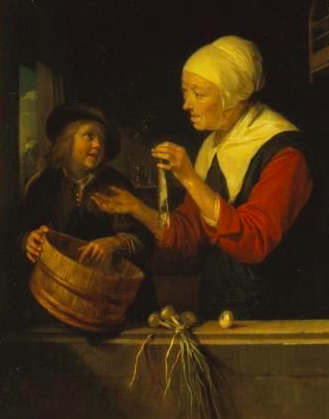
Note in the images and records that it appears that playing little merchants or simply being sent to the store to make small purchases is a genderless play activity that seems to start when they are old enough to reach up over the counter to hand over the payment.

Job Berckheyde (Dutch, 1630 - 1693)
The Bakery Shop, c. 1680 Here


The Idea of Playtime 1)  Free Play and 2) Modeling Adult Behavior Play:

The macro - or umbrella - idea is that children are not little adults, and need child size toys and actives for them to practice with, including both free playtime and modeling playtime to model adult behavior where mistakes can be made without major consequence; which is different than a child producing a tangible result with child labor or apprenticeship.

The "playtime revelation", as we'll call it, was developed during the 17th Century in the Netherlands and is unique to this region. This idea was first emphasized in the book, "Houwelyck" with the first chapter titled "Kinder-spel" published in 1618 by the Dutch author Jacob Cats (1577–1660). This book not only describes reserving time for play, but also provided images. It is important to point this out because often the 18th Century is cited as the time when "people" began to think of children as children and not little adults. However, it is roughly from the time of the publication of the Houwelyck book in 1618 that this is accurate and practiced by the average person in the Netherlands, New Netherland and New York during the 17th Century.

The Strong Museum of Play in Rochester, New York recently acquired a 17th century copy of the book and the images are available on-line Here. I recommend reading this article as it explains the unique culture of the Dutch. Even today, the State of New York is obsessed (relative to many states) with child welfare, the installation of a multitude of playgrounds, and even a museum dedicated to children at play. For those not familiar with New York, the State has provided free pre-school for 4 year olds since 1997, all children are covered by medical insurance since 2008 and New York City deemed it a necessity that every child in the city should not have to walk more than 10 minutes to find a green space, paying for it with public funds.

In addition to the below, ninepins, backgammon, ticktack and ball games were forbidden on the sabbath according to court records, plus checker boards are found in 17th and 18th inventories and marbles and dice are found in both NN and NY archeological digs:

Account Left by Josua and Mordakay Emriques 1st January 1656 (Shipped to NN):

24 dozen spinning tops that cost me 25 a dozen. That comes to a 2 lb. sack of sugar per spinning top.

4 gross [bell] rattles are 48 dozen that cost me 200 lb. sack of sugar per gross. That comes to a 17 lb. sack of sugar per dozen.

Monsieur Van Imbroch, Town of Kingston, NY a doctor, 1665: 
One childs chain of braided black and white sea-wan [trade beads] 

Sybrant van Schaick of Rensselaerswyck, a brewer, 1686:  
1 N.B. a little coral chain for Catie

Cornelius Steensyck, Mayor of Albany, and Merchant, 1686: 
Gold Child's whistle 
One children's ship 
One child's chest

Garret Jansen Roos, NYC, Carpenter, 1698: 
A whistle 

Peternela Tenycke, NYC, Shop Keeper, 1724: 


23 Joynted Babies .........................................................................1:3:0

A Parasoll of Toyes broken and whole .........................................2:0:0

A parasol of Small looking Glasses & Toy Pictures * ..................2:0:0

One "flaybanib", 1 bottle** e Sundry Toys .......................................5:0:6

A parcel of Toys.............................................................................0:7:7


*  In another section there is 1 small picture the words match up, possibly for doll house.
** Nipples for feeding babies have been found in archeological digs in the Albany region.


How affordable were those 23 jointed babies for 1:3:0? Well we can see that 27 stone jugs cost 2 pounds (or 27 jugs for 40 shillings or 480 pence). Also based on a 1722 inventory some comparisons are as follows: 16 yards of check [linen] 1:4:0, 13 and a quarter white flannel 1:3:2, 33 pairs of gloves for all sorts 2:0:0, 15 woolen caps 1:1:0 and a pair of men's worsted stockings. A 1719 inventory has 12 pairs of Boys stockings 1:4:0 and 14 yards red & white calico for 2:6:0 and 'imbosed' petticoat at 0:4:0. Considering a pair of men's stockings cost 0:5:0 and an 'imbosed' petticoat 0:4:0 we can see that this little dolls were relatively affordable and cost less than a pair of men's stockings or woman's petticoat. 23 Jointed babies for 1:3:0 or 23 shillings or 276 pence, 1 jointed baby at one shilling or 12 pence. For reenactors, it seems that the child of a farmer was just as likely to own a doll as a large estate owner. The main difference, based on one letter, is that a large estate holder may have silver miniature doll accessories for their child's doll, and a farmer's child may have little wooden tables and accessories for her doll. In either case, the kid would still have a doll at these prices. More interestedly, most as in the majority of kids would have the same quality doll because they were only a shilling per doll and being bought from a few shops.


Below an example of a toy and middle class family at a tavern: Jan Steen, Couple Dance, 1663


Later, as the French entered the 18th Century enlightenment they will adopt the idea that children need playtime and are not little adults; see Rousseau's classic book Emile published 1758. This is something we will come back to as how children are raised is not the only thing the French adopted from 17th Century Dutch which includes the fontage lace headbands and the robe that the shopkeeper above is wearing in the first painting which had become popular in the Netherlands by 1658 according to primary sources.

What we can see from quotes and documents is that while the idea of a child centered family is not invented by the Dutch (it was becoming universal in the 16th and 17th century),  they quantified and developed it into a system. Two types of  play were first developed in the Netherlands; 1) "playtime" with toys for fun and 2) "modeling" adult activities play such as making purchases and playing little merchant. This style of child rearing was imported to New Netherland and instilled to the point that after English sovereignty, it continued to be a part of many children's lives in New York.

Below is a thesis paper on children during the Dutch Golden Age with emphasis on the development of childhood and the influence of humanist ideals. The introduction gives a good overview for general understanding of why and what was developing in the Netherlands was so different.

"Constructions of Childhood in the Dutch Golden Age and Pedagogical Theory in the Dutch Republic as Reflected in Children’s Portraiture: The Dog Motif, The Apple Attribute, and the Meaningfulness of the Dutch Rinkelbel" Here.

Interestingly, something that is not found in probate inventories are bodices or stays for small children. This type of clothing was used by some parents in the hopes that their children will have straight backs and good posture. However, they can be mildly restrictive and possibly part of the reason they have not yet been found in New York inventories prior to the French and Indian War. Additionally, children in New Netherland and New York were not usually apprenticed until about 12 or 14 years old, having long childhoods seemingly with few chores. This free roaming childhood may have contributed to healthy bodies as there was a lack of restriction and repetitive movement.

There are a number of court cases where children are described as running through farmer's fields, playing outside the home, and other activities but not doing chores. There are a couple accounts about   low income families where the parents cannot afford to keep their children. The child is apprenticed at less than 12 years old but regularly runs away back to the parents and the parents reprimand the master for having hit their child.


Some Background and The Landscape:

Here, it is important to point out that most western nations were developing a concept of family that is different than in the middle ages. What would emerge are families where the ideal is "self-contained" (grand parents, parents, children, etc) vs. "extended" (includes 2nd. and 3rd. cousins, etc.). In addition to family make up,  children become "part of the family's purpose". An easy way to think of 17th Century families is vertical (which can include aunts and uncles who often take in orphaned related children and leave inheritances to nieces and nephews) vs. horizontal (2nd and 3rd cousins are living near each other or doing business together). Looking back we don't always notice the "reason for", but do see the end result. How were these children treated? How were expectations instilled - or more accurately enticed into?  In essence, how were children educated? How educations were given or the methods used are where the variations emerge, but are due to specific reasons.

The two ends of the spectrum appear to be the Dutch and the Puritan ways of education with the Dutch preferring "the carrot", playtime and followed by short 3-4 yr trade apprenticeships to the Puritan's literal use of "the stick" and long 7-8 yr trade apprenticeships.

"The Puritan family in England or the American colonies was seen as an institution based on ensuring the salvation of family members by proper education in the rules of good behaviour and the importance of faith. This responsibility was seen as resting primarily with the father, who was seen as the head of the household in religious as well as economic terms. The need was to ‘school’ the child in correct behaviour using appropriate punishments... to enforce discipline. Children were seen as inherently sinful and in need of guidance. At the extreme they were compared to wild animals whose spirit needed to be broken in order that they might develop the humility and obedience which would lead them to be good Christians (Ozment 1983)." - Histories of Childhood by John Clarke
"Not all families followed this extreme model, even in Protestant communities. Simon Schama describes seventeenth-century (Protestant) Holland as a society ‘besotted with the children’, where the idea of children and their pastimes played a major part in family life and in art (Schama 1987: 495)." - Histories of Childhood by John Clarke
"For the great mass of the population of Western European countries like Britain and France, children’s lives were characterized by poverty, hard labour and exploitation. This set up a contradiction which was to dominate writing and thinking about child- hood through the nineteenth century and into the twentieth. There was a contradiction between a romantic idealized view of childhood rooted in eighteenth-century Enlightenment and the brutal reality of most children’s lives." - Histories of Childhood by John Clarke

This is something we inherited from the Netherlands, and was practiced here in New Netherland and amazingly survived into English New York. While there would be many children that experience poverty in this colony, there was obviously a strong preference for creating ways for children to have a childhood which included charity and orphanages rather than work houses.

Below: abt. 1670 - A Poulterer's Shop - Gerrit Dou - https://www.wikiart.org/en/gerrit-dou/a-poulterer-s-shop


There is possibly a solid reason for the carrot method being used by the Dutch... these children were not being groomed solely for religious reasons (though it is noted that Dutch schools used religious books as daily reading material) but because they were part of a "family business". We have to remember, many families had mothers who grew food and sold it at market. Mothers were shop keepers or even merchants who owned ships, but also tavern keepers, tailors and shoemakers. This meant that children were part of the family business simply because mom was. There are actually very few images of children "helping" around the house and plenty of images of children running wild; playing cards, blowing bubbles, playing with spinning tops, and torturing their cats... plus a number a them going to the store to "practice" shopping.


Note the woman wants to sell him the one in her hand, and the kid points to a different one. Ode vrouw met haring en een jongen in een venster. Ook wel genoemd: de haringverkoopster. ca. 1650-1675. Pushkin Museum, Moscow.


This idea of placing not just a shopping money in the hands of children but an accounting book and expectation of making transactions has been part of New York's culture since the 17th Century. In 1724 Colwalder Colden records he makes mention of the Dutch children playing little merchants. However, It is important to note that by the 1700s, whether one was Dutch-Dutch, Walloon-Dutch, German-Dutch, Norwegian-Dutch, Swedish-Dutch, etc was not as clear as the previous century. Essentially, we could guess that all those people who had arrive prior to the English taking Sovereign control in 1674 were likely sharing a culture. This founding culture will survive English sovereignty and into the 18th Century.

It is one that the Englishmen Cadwallander Colden is willing to adopt.

To Mr. John Falconer Mercht. in London,

... Enclos'd you have a Bill of Excha. on Mr. David Mitchel at 30 days sight drawn by your Governor which I have endorsed to you...the remainder on my Own Acct. This small Adventure I send to please a little boy & Girl who want to be merchants as soon as they can speak like their play fellows the Dutch Children here. I know this consignment is but a small matter to trouble you with Yet I do not doubt you will take care to buy the following goods mention'd underneath to our best advantage. 
Envoy of Goods to be sent to Cadwallader Colden at New York as advice P. viz. 
6 ps Striped Narrow "Callemineos" } Lively colors but not Taudry *
12 ps Striped "Cambletts" } [same] **
1 ps black Broad Cloath about 12 s p yd } Let the "Cloaths" be substantial & well thickened
1 ps Drab colour Do about 20 s p yd} [same]
1 ps Do about 7 s p yd } [same]
6 ps good Sheldon viz. 2 ps of the same colour w/ each ps of "cloth" Sheldon of the fineness I intend come about
[... Continues...]

- Cadwallader Colden, New York May 4th, 1724

It is noted that Colden's daughter, though she did not grow up to be a merchant, became Ameria's first food scientist, second Botanist and would go on to apply Linnaean system (an analytical scientific system) for describing 300 different species of plants in New York. The organizational skills, and knowing when to ask the right questions likely developed during her little merchant years and seems to have benefited her. 

Along with some documentation and paintings, a rather interesting surviving example of how parents teach their children the workings of playing little merchant has survived, while easy to miss. A doll house owned by Petronella Oortman includes many rooms of a house... including what could be Mr. Oortam's parlor or office. In the office is both "Mr. Oortman" doll and a middle class man - a small merchant or shop keeper - likely settling accounts. With the middle class man is a similarly dresses little boy, a doll who's clothing clearly does not match up with the wealthier merchant son's clothes. We can see through Oortman's eyes her perspective on 1680s Netherlands. The doll-child's relative height appears to be similar to those children portrayed in paintings making purchases at stores. See image here.

An example of this culture surviving after the colonial era, is shown in an account by Mr. Rockafeller who lived in up-state New York. Mr. Rockefeller would give his son a little note book and a $1.50 allowance. Every time he made a purchase he was to record the amount spent. His son would present these little book to his parents, for praise and the rules were clear and repeatable. Interestedly, just as the Dutch were famous for their negotiations and contracts, this agreement was recorded as follows:

Memorandum between PAPA and JOHN. Regarding an Allowance.
1. Beginning with May 1st, John’s allowance is to be at the rate of One dollar and fifty cents ($1.50) per week.
2. At the end of each week during which John has kept his accounts accurately and to Papa’s satisfaction, the allowance for the succeeding week will be increased ten cents (10¢) over the week just ended, up to but not beyond a total per week of two dollars ($2.00).
3. At the end of each week during which John has not kept his accounts accurately and to Papa’s satisfaction, the allowance for the succeeding week shall be reduced ten cents (10¢) from the week just ended.
4. During any week when there have been no receipts or expenditures to record the allowance shall continue at the same rate as in the preceding week.
5. During any week when the account has been correctly kept but the writing and figuring are not satisfactory the allowance shall continue at the same rate as in the preceding week.
6. Papa shall be the sole judge as to whether an increase or a decrease is to be made.
7. It is understood that at least Twenty Per cent (20%) of the allowance shall be used for benevolences.
8. It is understood that at least Twenty Per cent (20%) of the allowance shall be saved.
9. It is understood that every purchase or expenditure made is to be put down definitely and clearly.
10. It is understood that John will make no purchases, charging the same to Mama or Papa, without the special consent of Mama, Papa or Miss Scales [a family governess].
11. It is understood that when John desires to make any purchases which the allowance does not cover, he will first gain the consent of either Mama, Papa, or Miss Scales, who will give him sufficient money with which to pay for the specific purchases, the change from which, together with a memorandum showing what items have been bought and at what cost and what amount is returned, is to be given to the person advancing the money, before night of the day on which the purchases are made.
12. It is understood that no governess, companion or other person in the household is to be asked by John to pay for any items for him, other than carfare.
13. To any savings from the date in this account which John may from time to time deposit in his bank account, in excess of the twenty per cent (20%) referred to in Item No. 8, Papa will add an equal sum for deposit.
14. The allowance above set forth and the agreement under which it shall be arrived at are to continue in force until changed by mutual consent. 
The above agreement approved and entered into by
John D. Rockefeller, Jr.
John D. Rockefeller 3rd
Smithsonian Magazine: See article here.


The children of New Netherland and New York are being taught from a young age the How-To of playing "little merchants" and may have been the precursor to our modern Lemonade stand; which is distinct and different from apprenticeships. They are opportunities for pre-teenaged children to "play" with real money, real accounting books, and real transactions. The accounting books seem to be as important as the transaction and valued as much as doing the deal. While they don't seem to be taught the savings part, they are consistently exposed to the charity part. The idea that the parents of both New Netherland and New York purposely set time aside to play at little merchants is a defining point of child rearing and cultural difference.


BONUS Painting:

Two more paintings Here and Here and a little kid possibly on her first mission not doing so well Here. A short article on the first Lemonade stand about 130 years ago Here.

1650-75: "The Grocery Shop", 1672 ~ Gerrit Dou - Shopkeeper in background behind counter, shop maid in red jacket, a young customer with bucket.


Instead of buying fabric and trying to have your kids sell it like colonial times, try the little merchant idea out in modern ways 1) At the grocery store, hand a toddler in a grocery cart seat the money for  the groceries to hand over to the clerk. 2) Try a Lemonade stand 3) When they are about 8 years old or older hand them $10, $15 or $20 at the start of the month (not week) and a small account book. Show them how to write their name, date and the amount given to them at the top. Then each week recount what they spent in a list.  (So they don't fall behind or wait too long and forget.) Then explain that the accounting book has to be turned in to you in order to receive their next allowance. When accounting is the only hoop they have to jump through, they will catch on quickly. The most amazing part... they develop patients ! 4) A separate payment for work done can be given like a monthly car detailing shop in the driveway where they earn $5 for cleaning out the car... and you play along as customer. Or put little one's to work making popsicles and you purchase them for a quarter each. Or with no money involved, instead of playing house or similar... play grocery store with pretend money and don't forget to remind them to sort and organize the food stuffs. It all adds up to skills that will get them ahead and doing math in their heads.