Showing posts with label Manhattan. Show all posts

Friday, June 1, 2018

Playing Little Merchants


"This small Adventure I send to please a little boy & Girl who want to be merchants as soon as they can speak like their play fellows the Dutch Children here." -  New York 1724


It is not unusual for visitors or new immigrants to notice that New Yorkers whether in Albany or Manhattan raise their kids a bit differently. Observers note that the children are raised with a sense of "industry" but also fun. The parents intended to instill two very important lessons 1) they needed to make time for  trade or mercantile-play just as much as 2) the parent needed to make time for fun-play. This tendency for New Yorkers to strike a balance between fun-playtime and little merchant-playtime in childhood, regardless of gender, may have been the fertilizer for the future mega-merchants that would rule over the massive warehousing businesses that would eventually lead to the stock exchange and Wall St.

The citizens of the Netherlands, New Netherlands and even English New York did something rather surprising with their children. They got it in their heads that 1) children were not little adults, 2) a proper parent reserves time specifically for both "free playtime" and "modeling playtime" and 3) little ones could be trusted with money !

Note in the images and records that it appears that playing little merchants or simply being sent to the store to make small purchases is a genderless play activity that seems to start when they are old enough to reach up over the counter to hand over the payment.

Job Berckheyde (Dutch, 1630 - 1693)
The Bakery Shop, c. 1680 Here


The Idea of Playtime 1)  Free Play and 2) Modeling Adult Behavior Play:

The macro - or umbrella - idea is that children are not little adults, and need child size toys and actives for them to practice with, including both free playtime and modeling playtime to model adult behavior where mistakes can be made without major consequence; which is different than a child producing a tangible result with child labor or apprenticeship.

The "playtime revelation", as we'll call it, was developed during the 17th Century in the Netherlands and is unique to this region. This idea was first emphasized in the book, "Houwelyck" with the first chapter titled "Kinder-spel" published in 1618 by the Dutch author Jacob Cats (1577–1660). This book not only describes reserving time for play, but also provided images. It is important to point this out because often the 18th Century is cited as the time when "people" began to think of children as children and not little adults. However, it is roughly from the time of the publication of the Houwelyck book in 1618 that this is accurate and practiced by the average person in the Netherlands, New Netherland and New York during the 17th Century.

The Strong Museum of Play in Rochester, New York recently acquired a 17th century copy of the book and the images are available on-line Here. I recommend reading this article as it explains the unique culture of the Dutch. Even today, the State of New York is obsessed (relative to many states) with child welfare, the installation of a multitude of playgrounds, and even a museum dedicated to children at play. For those not familiar with New York, the State has provided free pre-school for 4 year olds since 1997, all children are covered by medical insurance since 2008 and New York City deemed it a necessity that every child in the city should not have to walk more than 10 minutes to find a green space, paying for it with public funds.

In addition to the below, ninepins, backgammon, ticktack and ball games were forbidden on the sabbath according to court records, plus checker boards are found in 17th and 18th inventories and marbles and dice are found in both NN and NY archeological digs:

Account Left by Josua and Mordakay Emriques 1st January 1656 (Shipped to NN):

24 dozen spinning tops that cost me 25 a dozen. That comes to a 2 lb. sack of sugar per spinning top.

4 gross [bell] rattles are 48 dozen that cost me 200 lb. sack of sugar per gross. That comes to a 17 lb. sack of sugar per dozen.

Monsieur Van Imbroch, Town of Kingston, NY a doctor, 1665: 
One childs chain of braided black and white sea-wan [trade beads] 

Sybrant van Schaick of Rensselaerswyck, a brewer, 1686:  
1 N.B. a little coral chain for Catie

Cornelius Steensyck, Mayor of Albany, and Merchant, 1686: 
Gold Child's whistle 
One children's ship 
One child's chest

Garret Jansen Roos, NYC, Carpenter, 1698: 
A whistle 

Peternela Tenycke, NYC, Shop Keeper, 1724: 


23 Joynted Babies .........................................................................1:3:0

A Parasoll of Toyes broken and whole .........................................2:0:0

A parasol of Small looking Glasses & Toy Pictures * ..................2:0:0

One "flaybanib", 1 bottle** e Sundry Toys .......................................5:0:6

A parcel of Toys.............................................................................0:7:7


*  In another section there is 1 small picture the words match up, possibly for doll house.
** Nipples for feeding babies have been found in archeological digs in the Albany region.


How affordable were those 23 jointed babies for 1:3:0? Well we can see that 27 stone jugs cost 2 pounds (or 27 jugs for 40 shillings or 480 pence). Also based on a 1722 inventory some comparisons are as follows: 16 yards of check [linen] 1:4:0, 13 and a quarter white flannel 1:3:2, 33 pairs of gloves for all sorts 2:0:0, 15 woolen caps 1:1:0 and a pair of men's worsted stockings. A 1719 inventory has 12 pairs of Boys stockings 1:4:0 and 14 yards red & white calico for 2:6:0 and 'imbosed' petticoat at 0:4:0. Considering a pair of men's stockings cost 0:5:0 and an 'imbosed' petticoat 0:4:0 we can see that this little dolls were relatively affordable and cost less than a pair of men's stockings or woman's petticoat. 23 Jointed babies for 1:3:0 or 23 shillings or 276 pence, 1 jointed baby at one shilling or 12 pence. For reenactors, it seems that the child of a farmer was just as likely to own a doll as a large estate owner. The main difference, based on one letter, is that a large estate holder may have silver miniature doll accessories for their child's doll, and a farmer's child may have little wooden tables and accessories for her doll. In either case, the kid would still have a doll at these prices. More interestedly, most as in the majority of kids would have the same quality doll because they were only a shilling per doll and being bought from a few shops.


Below an example of a toy and middle class family at a tavern: Jan Steen, Couple Dance, 1663


Later, as the French entered the 18th Century enlightenment they will adopt the idea that children need playtime and are not little adults; see Rousseau's classic book Emile published 1758. This is something we will come back to as how children are raised is not the only thing the French adopted from 17th Century Dutch which includes the fontage lace headbands and the robe that the shopkeeper above is wearing in the first painting which had become popular in the Netherlands by 1658 according to primary sources.

What we can see from quotes and documents is that while the idea of a child centered family is not invented by the Dutch (it was becoming universal in the 16th and 17th century),  they quantified and developed it into a system. Two types of  play were first developed in the Netherlands; 1) "playtime" with toys for fun and 2) "modeling" adult activities play such as making purchases and playing little merchant. This style of child rearing was imported to New Netherland and instilled to the point that after English sovereignty, it continued to be a part of many children's lives in New York.

Below is a thesis paper on children during the Dutch Golden Age with emphasis on the development of childhood and the influence of humanist ideals. The introduction gives a good overview for general understanding of why and what was developing in the Netherlands was so different.

"Constructions of Childhood in the Dutch Golden Age and Pedagogical Theory in the Dutch Republic as Reflected in Children’s Portraiture: The Dog Motif, The Apple Attribute, and the Meaningfulness of the Dutch Rinkelbel" Here.

Interestingly, something that is not found in probate inventories are bodices or stays for small children. This type of clothing was used by some parents in the hopes that their children will have straight backs and good posture. However, they can be mildly restrictive and possibly part of the reason they have not yet been found in New York inventories prior to the French and Indian War. Additionally, children in New Netherland and New York were not usually apprenticed until about 12 or 14 years old, having long childhoods seemingly with few chores. This free roaming childhood may have contributed to healthy bodies as there was a lack of restriction and repetitive movement.

There are a number of court cases where children are described as running through farmer's fields, playing outside the home, and other activities but not doing chores. There are a couple accounts about   low income families where the parents cannot afford to keep their children. The child is apprenticed at less than 12 years old but regularly runs away back to the parents and the parents reprimand the master for having hit their child.


Some Background and The Landscape:

Here, it is important to point out that most western nations were developing a concept of family that is different than in the middle ages. What would emerge are families where the ideal is "self-contained" (grand parents, parents, children, etc) vs. "extended" (includes 2nd. and 3rd. cousins, etc.). In addition to family make up,  children become "part of the family's purpose". An easy way to think of 17th Century families is vertical (which can include aunts and uncles who often take in orphaned related children and leave inheritances to nieces and nephews) vs. horizontal (2nd and 3rd cousins are living near each other or doing business together). Looking back we don't always notice the "reason for", but do see the end result. How were these children treated? How were expectations instilled - or more accurately enticed into?  In essence, how were children educated? How educations were given or the methods used are where the variations emerge, but are due to specific reasons.

The two ends of the spectrum appear to be the Dutch and the Puritan ways of education with the Dutch preferring "the carrot", playtime and followed by short 3-4 yr trade apprenticeships to the Puritan's literal use of "the stick" and long 7-8 yr trade apprenticeships.

"The Puritan family in England or the American colonies was seen as an institution based on ensuring the salvation of family members by proper education in the rules of good behaviour and the importance of faith. This responsibility was seen as resting primarily with the father, who was seen as the head of the household in religious as well as economic terms. The need was to ‘school’ the child in correct behaviour using appropriate punishments... to enforce discipline. Children were seen as inherently sinful and in need of guidance. At the extreme they were compared to wild animals whose spirit needed to be broken in order that they might develop the humility and obedience which would lead them to be good Christians (Ozment 1983)." - Histories of Childhood by John Clarke
"Not all families followed this extreme model, even in Protestant communities. Simon Schama describes seventeenth-century (Protestant) Holland as a society ‘besotted with the children’, where the idea of children and their pastimes played a major part in family life and in art (Schama 1987: 495)." - Histories of Childhood by John Clarke
"For the great mass of the population of Western European countries like Britain and France, children’s lives were characterized by poverty, hard labour and exploitation. This set up a contradiction which was to dominate writing and thinking about child- hood through the nineteenth century and into the twentieth. There was a contradiction between a romantic idealized view of childhood rooted in eighteenth-century Enlightenment and the brutal reality of most children’s lives." - Histories of Childhood by John Clarke

This is something we inherited from the Netherlands, and was practiced here in New Netherland and amazingly survived into English New York. While there would be many children that experience poverty in this colony, there was obviously a strong preference for creating ways for children to have a childhood which included charity and orphanages rather than work houses.

Below: abt. 1670 - A Poulterer's Shop - Gerrit Dou - https://www.wikiart.org/en/gerrit-dou/a-poulterer-s-shop

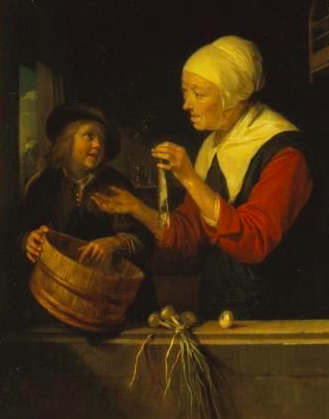


There is possibly a solid reason for the carrot method being used by the Dutch... these children were not being groomed solely for religious reasons (though it is noted that Dutch schools used religious books as daily reading material) but because they were part of a "family business". We have to remember, many families had mothers who grew food and sold it at market. Mothers were shop keepers or even merchants who owned ships, but also tavern keepers, tailors and shoemakers. This meant that children were part of the family business simply because mom was. There are actually very few images of children "helping" around the house and plenty of images of children running wild; playing cards, blowing bubbles, playing with spinning tops, and torturing their cats... plus a number a them going to the store to "practice" shopping.


Note the woman wants to sell him the one in her hand, and the kid points to a different one. Ode vrouw met haring en een jongen in een venster. Ook wel genoemd: de haringverkoopster. ca. 1650-1675. Pushkin Museum, Moscow.


This idea of placing not just a shopping money in the hands of children but an accounting book and expectation of making transactions has been part of New York's culture since the 17th Century. In 1724 Colwalder Colden records he makes mention of the Dutch children playing little merchants. However, It is important to note that by the 1700s, whether one was Dutch-Dutch, Walloon-Dutch, German-Dutch, Norwegian-Dutch, Swedish-Dutch, etc was not as clear as the previous century. Essentially, we could guess that all those people who had arrive prior to the English taking Sovereign control in 1674 were likely sharing a culture. This founding culture will survive English sovereignty and into the 18th Century.

It is one that the Englishmen Cadwallander Colden is willing to adopt.

To Mr. John Falconer Mercht. in London,

... Enclos'd you have a Bill of Excha. on Mr. David Mitchel at 30 days sight drawn by your Governor which I have endorsed to you...the remainder on my Own Acct. This small Adventure I send to please a little boy & Girl who want to be merchants as soon as they can speak like their play fellows the Dutch Children here. I know this consignment is but a small matter to trouble you with Yet I do not doubt you will take care to buy the following goods mention'd underneath to our best advantage. 
Envoy of Goods to be sent to Cadwallader Colden at New York as advice P. viz. 
6 ps Striped Narrow "Callemineos" } Lively colors but not Taudry *
12 ps Striped "Cambletts" } [same] **
1 ps black Broad Cloath about 12 s p yd } Let the "Cloaths" be substantial & well thickened
1 ps Drab colour Do about 20 s p yd} [same]
1 ps Do about 7 s p yd } [same]
6 ps good Sheldon viz. 2 ps of the same colour w/ each ps of "cloth" Sheldon of the fineness I intend come about
[... Continues...]

- Cadwallader Colden, New York May 4th, 1724

It is noted that Colden's daughter, though she did not grow up to be a merchant, became Ameria's first food scientist, second Botanist and would go on to apply Linnaean system (an analytical scientific system) for describing 300 different species of plants in New York. The organizational skills, and knowing when to ask the right questions likely developed during her little merchant years and seems to have benefited her. 

Along with some documentation and paintings, a rather interesting surviving example of how parents teach their children the workings of playing little merchant has survived, while easy to miss. A doll house owned by Petronella Oortman includes many rooms of a house... including what could be Mr. Oortam's parlor or office. In the office is both "Mr. Oortman" doll and a middle class man - a small merchant or shop keeper - likely settling accounts. With the middle class man is a similarly dresses little boy, a doll who's clothing clearly does not match up with the wealthier merchant son's clothes. We can see through Oortman's eyes her perspective on 1680s Netherlands. The doll-child's relative height appears to be similar to those children portrayed in paintings making purchases at stores. See image here.

An example of this culture surviving after the colonial era, is shown in an account by Mr. Rockafeller who lived in up-state New York. Mr. Rockefeller would give his son a little note book and a $1.50 allowance. Every time he made a purchase he was to record the amount spent. His son would present these little book to his parents, for praise and the rules were clear and repeatable. Interestedly, just as the Dutch were famous for their negotiations and contracts, this agreement was recorded as follows:

Memorandum between PAPA and JOHN. Regarding an Allowance.
1. Beginning with May 1st, John’s allowance is to be at the rate of One dollar and fifty cents ($1.50) per week.
2. At the end of each week during which John has kept his accounts accurately and to Papa’s satisfaction, the allowance for the succeeding week will be increased ten cents (10¢) over the week just ended, up to but not beyond a total per week of two dollars ($2.00).
3. At the end of each week during which John has not kept his accounts accurately and to Papa’s satisfaction, the allowance for the succeeding week shall be reduced ten cents (10¢) from the week just ended.
4. During any week when there have been no receipts or expenditures to record the allowance shall continue at the same rate as in the preceding week.
5. During any week when the account has been correctly kept but the writing and figuring are not satisfactory the allowance shall continue at the same rate as in the preceding week.
6. Papa shall be the sole judge as to whether an increase or a decrease is to be made.
7. It is understood that at least Twenty Per cent (20%) of the allowance shall be used for benevolences.
8. It is understood that at least Twenty Per cent (20%) of the allowance shall be saved.
9. It is understood that every purchase or expenditure made is to be put down definitely and clearly.
10. It is understood that John will make no purchases, charging the same to Mama or Papa, without the special consent of Mama, Papa or Miss Scales [a family governess].
11. It is understood that when John desires to make any purchases which the allowance does not cover, he will first gain the consent of either Mama, Papa, or Miss Scales, who will give him sufficient money with which to pay for the specific purchases, the change from which, together with a memorandum showing what items have been bought and at what cost and what amount is returned, is to be given to the person advancing the money, before night of the day on which the purchases are made.
12. It is understood that no governess, companion or other person in the household is to be asked by John to pay for any items for him, other than carfare.
13. To any savings from the date in this account which John may from time to time deposit in his bank account, in excess of the twenty per cent (20%) referred to in Item No. 8, Papa will add an equal sum for deposit.
14. The allowance above set forth and the agreement under which it shall be arrived at are to continue in force until changed by mutual consent. 
The above agreement approved and entered into by
John D. Rockefeller, Jr.
John D. Rockefeller 3rd
Smithsonian Magazine: See article here.


The children of New Netherland and New York are being taught from a young age the How-To of playing "little merchants" and may have been the precursor to our modern Lemonade stand; which is distinct and different from apprenticeships. They are opportunities for pre-teenaged children to "play" with real money, real accounting books, and real transactions. The accounting books seem to be as important as the transaction and valued as much as doing the deal. While they don't seem to be taught the savings part, they are consistently exposed to the charity part. The idea that the parents of both New Netherland and New York purposely set time aside to play at little merchants is a defining point of child rearing and cultural difference.


BONUS Painting:

Two more paintings Here and Here and a little kid possibly on her first mission not doing so well Here. A short article on the first Lemonade stand about 130 years ago Here.

1650-75: "The Grocery Shop", 1672 ~ Gerrit Dou - Shopkeeper in background behind counter, shop maid in red jacket, a young customer with bucket.


Instead of buying fabric and trying to have your kids sell it like colonial times, try the little merchant idea out in modern ways 1) At the grocery store, hand a toddler in a grocery cart seat the money for  the groceries to hand over to the clerk. 2) Try a Lemonade stand 3) When they are about 8 years old or older hand them $10, $15 or $20 at the start of the month (not week) and a small account book. Show them how to write their name, date and the amount given to them at the top. Then each week recount what they spent in a list.  (So they don't fall behind or wait too long and forget.) Then explain that the accounting book has to be turned in to you in order to receive their next allowance. When accounting is the only hoop they have to jump through, they will catch on quickly. The most amazing part... they develop patients ! 4) A separate payment for work done can be given like a monthly car detailing shop in the driveway where they earn $5 for cleaning out the car... and you play along as customer. Or put little one's to work making popsicles and you purchase them for a quarter each. Or with no money involved, instead of playing house or similar... play grocery store with pretend money and don't forget to remind them to sort and organize the food stuffs. It all adds up to skills that will get them ahead and doing math in their heads.


Saturday, January 20, 2018

Rucksack and Knapsack - 1530 - 1755


1651 Probate Inventory, Manhattan, a brewer, een "reyssackie" [a rucksack] 

The rucksack and knapsack are items that can easily be traced back to the 1530s and were used throughout the 1600s and 1700s. The rucksack is often seen on people when carried on their backs as a cross body bag. Wheres, knapsacks are smaller and carried slung over the shoulder or hanging from a stick vagabond style. The two bags form a set used by travelers; though sometimes I get the impression that they are one and the same.

Below: Cropping of a traveler visiting a "The Doctor's surgery", Attributed to Michiel van Musscher (Rotterdam 1645-1705 Amsterdam)


In Inventories:

For reenactors this is a very practical and useful item, which can be worn by men, women and children. It also allows you to keep your arms free during events, while keeping anything you deme too valuable to leave behind in a tent with you at all times but on your back. Below are references to the rucksack. I don't have a knapsack in the inventories from the 1640s-1790s.

New Netherland Probate Inventories:

1651, Manhattan, a brewer, een "reyssackie" (a rucksack)
1664, Wiltwijk [Kingston, NY], a farmer, a rucksack

Thanks to Mr. Oovenmeester Richard, a 17th Century reenactor, who found the first photo of a rucksack for me; it also lead me to find a few others. The black bag below is an extant from the 17th Century and is located at the Geheugenvan Nederland Museum Link. And another photo Here and Here ... and one more Here.

FYI, if you type in "draagzak" or "voorraadzak" you get the photos linked above and baby carriers.


Making a Connection:

After seeing a number of these rucksacks in paintings and images I got it in my head that this would be a handy bag to take with me to the park, when visiting historic sites, and simply to enjoy a connection with the people who made the journey across the Atlantic. I managed to find a modern maker of these bags and thought I would share. I don't get a referral fee, instead my goal is to supply my readers with links to well made items produced by small shops just like they would have 300 years ago.

Check out Chris Thomas's 17th Century linen canvas and (pictured below) a golden goatskin rucksack which are "made to order" items, you get to pick what your rucksack is made of. Chris can be contacted through email: christophus@aol.com or through Facebook at Christophus Leatherwork & Trading. His Facebook page is a tour through time, with many images of items Chris is working on for special orders and even museums.


Plus, this is really awesome 17th century water bottle ! Here. by Graham Webb.  Image woman with water bottle here.


Historical References:

Any reenactor or historic site whether in England, Europe or America knows that primary sources count when picking out what to use or display. Here are documents that mention these items from 1755 back to 1530 and give clues on how they are used.


1755 - "...the knight and squire therefore, dismounting, and leaving the ass and Rozinante at pleasure to regale themselves with the rich pasture, emptied their knapsack, and without any ceremony, attacked the contents, which they ate together like good friends..." - The History and Adventures of the Renowned Don Quixote, Volume 1, 1755

1716 - "...On the other hand the mis-spelling of English words such as " consort " for "concert," "snapsack" for "knapsack," "rabbet" for "rabbit," "teint" for " tint ...and the use of "my Lord" for "Sire" or "Signeur", give the idea that the translation published by Tonson has been made not by an Englihsman but by a Foreigner." - Book: Gil Blas, By Alain Rene Le Sage, 1716.

1708 - "Havresac, f.m. Bifsac de fantassin. Een Soldaat knapzak." (Also Besace, Bifsac. Bedelzak, knapzak) - Groot Fransch en Nederduits woordenboek, 1708 

1708 - "Havresac, f.m. Bif-bag of infantryman. A Soldier's Knapsack." (Begging bag, also a knapsack) - Groot Fransch en Nederduits woordenboek, 1708 

1688 - "I heard Sir Thomas Fairfax relate of a Souldjer in Ireland, who having got his Passport to go for England, as he past through a Wood with his Knapsack upon his Back, being weary, he fate down under a Tree, where he open'd his Knapsack, and fell to some Victuals he had; ..." - Book: "Epistolæ Ho-Elianæ: Familiar Letters, Domestic and Forren. Divided Into Four Books, Partly Historical, Political, Philosophical, Upon Emergent Occasions", 1688

1530 - "...Gott für einen narren/der unnötige stifte uns ordnet/und nicht wuste/ was er uns stifften sollen odder als were er ein knapsack / der faule untuchtige wahr umbhertruge und unsanböte /..." - "Vermanung zum Sacrament des leibs und bluts unsers Herrn" by Martin Luther 1530

Translation:
1530 - "...God for a fool / useless pen arranges us / and not wust / what he should stifften us or as if he were a knapsack / lazy naughty true umbhertruge and unsanböte / ..." - "Vermanung zum Sacrament des leibs und bluts unsers Herrn" by Martin Luther 1530.


This last one, 1530, was a bit too hard for me to translate correctly. But we get the idea that everybody liked knapsacks and they had one particular purpose, to carry food. This is compared to a rucksack which was used for travel.


Sunday, December 17, 2017

Women, Cellos and Viola de Gambas

[They] are taught Music, and to play on all sorts of Instruments, in which some of' em are excellent Performers. Apologia actually passes for the finest Singer, and Anna-Maria's for the first Violin in Italy. The Concourse of People to this Church on Sundays and Holidays is extraordinary. - 

The Memoirs of Charles-Lewis, Baron de Pollnitz, Karl Ludwig, 1739


Did women play the cello or viola de gamba ?

The sound of the cello is enchanting, powerful and elegant; while the viola is rich, complicated and sophisticated. It is almost as if each one has its own attitude. Its not surprising that the women of Europe played cellos and de 'gambas'. For that matter, we can also see that they mastered the violin and viol / viola.

There is this general talk; that "women" did not do this or that, because it was not "becoming" or was "suggestive". If this were true, we would not have such a good sampling of European women playing these instruments. Anna-Maria of Venice who was considered the first violin of Italy will be one who was remembered. However, by the time Anna-Maria comes on the scene in the 1730s, Italy had had women playing instruments from both the violin and viola family since at least the 16th Century during their Renaissance. Italy's record for including women in orchestras, quartets, and the similar will be contagious to other nations as they enter their own renaissances. Anna-Maria of Venice will not be alone; others in the first half of the 18th Century who were trained violist including Madame Henriette (Louis XV's daughter) of France who played the large viola de gamba, and Madame la marquise de "Grancey" played the tenor viola, small, but still played upright on the knee. Later during the second half of the 18c, Ann Ford of England who played the 'viol de gamba' along with the 'Saltero', Spanish guitar, archlute, and the piano-forte, began private concerts in October 1758 and public concerts in March 1760. So, here we can see that it was acceptable for women in both Europe and England to play the viola de 'gamba'. Imagery and the quote below, help us see that some women also played the cello.


Image of Madame Henriette:


How is it that on one hand we have many primary sources pointing out women by name who played large instruments that sat between the knees plus the likes of violins and viola and on the other hand this idea that some think that a 16th, 17th & 18th Century person would find this "suggestive" ?

The answer to if women during colonial times played cellos and de gamba between the knees, or if at all, is based on one particular document that circulated among musicians. However, make note of the date. This quote both confirms that the author witness women playing cellos, and between the knees, though disapproved of it. Essentially, for female musicians who also do reenacting, both before and during the American Revolution the cello and viola de gamba are fair game.


From the book: The First Fleet Piano: Volume One: A Musician’s View:

"An anonymous writer in the Musikalischer Almanach fur 1784..., observing that when a woman plays a cello she must spread her legs, prudishly remarked: 'In thousands of people it calls up pictures that it ought not to call up.' [ However, ] If a woman played the cello, it was recommended that she play it 'in the side-saddle position, an attitude that persisted in certain educational institutions well into the twentieth century"


Its interesting that gender lines became more restrictive after the Rev. war. However, this is not unusual nor the only example of this happening. What is more important is that we see a shift in attitude where previously, all women sat with their legs apart to later in the 19c sitting with the knee together. So, playing a cello or de 'gamba' between the knees for a woman was not a big deal.


Image of 19th Century Queen Victoria of England:


If you would like a coffee / tea / chocolate break before delving into the nitty-gritty ... scroll down to the end for a tour of paintings of women with their cellos and violas. They are rather beautiful. 


So, if there was not an issue with women during the 16th, 17th and 18th Century playing the cello and viola de gamba, were there any limitations on which string instruments they could play ?  First, what is a Viola compared to a Violin ?

What are Violas ?

While cellos are well know, and part of the violin family; its counter part the viola de gamba is part of the viol / viols / viola family. The de gamba and all the viols have a flat back, the shoulders of the viol are sloped, and are easy to spot due to having a /C/ whole in the front. Whereas, violins have /S/ shaped wholes. The viol also has 5-7 stings and frets whereas the violin only has four strings.


All viols are played upright, like the cello, but unlike the violin. The Italian term for viol is viola de gamba which means... viol for the knee. As we saw with the adoption of the tabbaard gown from Venice to the Netherlands and onto America... we see another trend with the viola de gamba; bass and tenor. Where, early images show Italian musicians (female) playing the de gamba, and then the Dutch; we do not have images of women in America playing the viola.. but there isn't much with the men either.

What are a Violins ?

They are musical instruments developed in 16th century Italy; also called violas da 'braccio'. The violins have four strings and s-shapes wholes. Most people have seen violins, cellos and bass violins; so we'll let readers follow up on their history outside of this post.


Rich, complicated, and sophisticated:


Inventories of New York:

Violas may have arrived prior to the 18th century. In 1692, there are 30 bunches of "fiddle" strings for sale in a NY store; whether or not the recorder knew the difference between a violin string and ones for a viol is unknown. However, 30 bunches of strings is a good number, possibly a 2 or more year supply for the store keeper. With this in mind, we may safely guess that there were a dozen or more people who played instruments from the violin and viola families.

The New York governor (1720-1728) William Burnet has a "large Violin or Tenor Fidle" in his inventory. Tenor violins or tenor fiddles, are what English called the viola. If we use this as the reference for the 1692 inventory we see that the "30 bunches of fiddle strings" mentioned above, were likely viola strings.

As to whether women played the viola, we get a clue from the wind instruments being sold by another retailer. Recorders, it appears, were purchased for boys and girls at school age during the 17th Century in New York. So in this instance, we see that another instrument that is considered by some in hind sight as too suggestive for women (wind instruments) were being played by little girls.


Violins vs. Violas:

There may be some gender bias between the violin and viola. Though, we first have to note that there are women that play instruments from both families and men did the same. With this in mind, if there is a gender bias, it is likely coming not from a top down, but individual to individual. In other words, a teacher may choose to not teach girls.


Advertisements:

Here we can clearly see that the de gamba and other viols are in fact in New York. We can see violins, and... bass viols !! A viol, is a viola, and they are for sale in New York. In the images near the bottom of the page we see both the bass viol and tenor viol being played by women in Europe.


1759 - Imported Musical Instruments.—To be sold by a Gentleman who lodges at Widow Darcey's nigh the Ship-Yards, opposite to William Walton's, Esq; and who is to go soon out of Town; exceeding good German Flutes, for three Dollars each; likewise others with 2, 3, 4 or 5 middle pieces to change the Tones and Voice, do. likewise Base Viol Strings of all Sizes, and silvered Ones for Basses, Violins and Tenors. A great Collection of wrote and printed Musick from Italy and England. The newest Sets of Scotch and Irish Tunes, and Airs in Score, Base Viol and Fiddle Bridges, rulled Musick Paper in Sheets and in Books, German Flute Concertos, Sonatas, Duets and Solos, and a great many other Things in the musical Way, imported by himself from Naples and London. Likewise, two fine Violins, a Girls six-stringd Bass Viole, and a foreign Pocket Gun.—The New-York Mercury, August 13, 1759.

1767 - Robert Horne, Musical Instrument-Maker, from London, at Mr. Francis Cooley's, on Golden-Hill; Makes and repairs Violins, bass viols, tenor viols, Æolius harps, gauiters, German flutes, Kitts, violin bows, &c. in the neatest and compleatest manner. All orders punctually obey'd, with the quickest dispatch;: The favour of Gentlemen and Ladies shall be duly honour'd with their Commands. N.B. Merchants may be supplied with any of the above, cheaper than in London on proper notice given.—The New-York Mercury, September 14, 1767.

1772 - Robert Horne, Musical Instrument-Maker, from London, on Golden-Hill, near Burling's Slip, Makes and repairs musical instruments, viz. Violins, tennors, violon-cellos, guittars, kitts, aeolus harps, spinnets, and spinnets jacks, violin bows, tail-pieces, pins, bridges; bows hair'd, and the best Roman Strings, &c. N.B. Country stores supply'd on the shortest notice.—The New-York Gazette and the Weekly Mercury, January 6, 1772.


Gendered vs. Gendered Neutral Advertisements:

It seem that some instructors will only teach violin to men; however, there is no mention of viola / viol in the below adds. The lack of mention for the viola in these adds, may be related to violas being popular among woman, while violins were also likely played by females, some male instructors may not of deemed four string instruments as a feminine pursuit. Though, other teachers target both men and women. We will note that while bass violins are in the violin family, bass fiddles are in the viola. When one sees a "double bass" it is a instrument that hovers between the two families. Though, it is possible, that just as some women may offer lessons to only females, some men would also only offer lessons to males. This last point is possibly the likely answer as instruction classes for only men or only women still exists today. Below we see violin and bass violin instruction offered to only men.

Examples of gender-neutral or inclusive:

1758 - Alexander Dienval.—This is to give Notice, That the Violin and German Flute, are taught in the Space of two or three Months each, by Alexander V. Dienval, at Mr. Elphinstone's House in the Slott.—The New-York Mercury, September 18, 1758.

1768 - Wall, Comedian, Engages to teach Ladies and Gentlemen to Play on the Guitar to prevent Trouble, his terms are to such as chuse to be waited on at the Houses; One Guinea Entrance, and the same per Month for which he pays Attendance, Three Times a Week. Ladies and Gentlemen, who may think proper to honour him with their Commands, by sending to his lodgings, at Mr. Sproul's, in Depyster's-Street, will be immediately waited on.—The New-York Mercury, January 11, 1768.


Males only:

1753 - Charles Love, Musician, from London, at his lodgings at the house of Mrs. George, in the first lane from the Bowling-Green, that leads to the North-River, proposes teaching gentlemen musick on the following instruments, Viz. Violin, Hautboy, German and Common Flutes, Bassoon, French Horn, Tenor, and Base Violin, if desired....The New York Mercury, July 2, 1753.

1759 - William Charles Hulet.—This is to Give Notice, That the Violin is taught in so plain and easy a Method (that young Gentlemen of eight or nine years old may be capable of learning in a short Time) by W. C. Hulet, at the House of Robert Wallace, joiner, in the Broad-street,...—The New-York Gazette, September 24, 1759.


The Fashionable Cello and Viola de Gamba:

Anyone notice a trend? What is fashionable in Venice doesn't stay in Venice. Whether it is Venitian pearls, the tabbaard gown and now the viola; all things fashionable seem to make it to New Newnetherland and New York.

First we see violas become popular in Italy (but were widely played in Spain too). Then the Dutch and likely Flemish people playing the same instruments during their Golden Age. Here is where gets a bit tricky; did the viola, which was popular in the Netherlands, come over in the 1650s with the tabbaard and all those venetian pearls??? 

Or adopted after the final transfer of sovereign power to the English in the 1670s? In either case, 'fiddles' and possibly violas were here in the 1690s. When the age of Enlightenment comes, the French are seen with these instruments in tandem with New York. The violas, don't seem to have lost their attractiveness in New York or America during the 18th century. 

This trend where out of one economic-cultural upswing into another (Renaissance to Golden Age to Enlightenment) a fashion or other material good is adopted, is not isolated to these three samples. We will see more threading together of these ages in future posts where a material good (and cultural norms) developed in Italy, is adopted in the Netherlands and then brought over to New Netherland or New York. Alternatively, there are a number of items that are developed in other nations, adopted by Golden Age Dutch, and transferred to America. While much of this is rooted in economics and commercialism in the colonial sense, it is also driven by a customer curious and open to new experiences.

I hope you enjoy the below image-tour through history ! Happy Holidays !

In Images: 

1) Italy, The outdoor Concert, artist unknown, painting in the Hotel Lallemand, Bourges, France 16c.


2) Netherlands, anoniem, Vrouw bespeelt een strijkinstrument about 1600-1610.


3) German, VIOLA da GAMBA, A consort of viols by Freyse, German, 1630s


4) Netherland, Jan Olis - Musical Evening, 1630s


5) English, Anthonis van Dyck - Portrait of Mary Ruthann 1638


5) Netherlands, Concert - Jacob van Loo (1652)


7) Gabriël Metsu, Netherlands: Interieur van een schildersatelier met een kunstenaar die een vrouw met een viola da gamba schildert. ca. 1655.


8) Metsu, Netherlands, 1658


9) Paolo Caliari, il Veronese


10) Metsu, Netherlands, dated to 1663


11) Gerard Pietersz. van Zijl, 1658 - 1677


12) Portrait of a Lady Playing a Viola da Gamba, 1675, by Caspar Netscher


13) Vrouw bespeelt een viola da gamba, Pieter Schenk (I), 1670 - 1713


14) Nicolas Bonnart (France, 1637-1717) Recueil des modes de la cour de France, 'Dame qui Jouë de la Viole en Chantant' France, Paris, circa 1682-1686 14) 


15) Madame la marquise de Grancey by Antoine Trouvain abt. 1700


16) 1750s - A lady playing the pardessus de viol, "Perronneau"


17) Madame Henriette (Louis XV's daughter) playing the Viola da Gamba in Court dress by Jean-Marc Nattier (1685- 1766)


For the above list of images, I left out four more of Dutch and Italian women from 1550-1650s which would bring the total to 21; but there is a trend. With all the images together, the women of Italy were actively playing string instruments in the 16th Century. Dutch ladies picked up the same instruments in the 17th Century, and it became all the rage in France at the start of the 18th Century.

With this amount of imagery, we can see playing large string instruments was acceptable, in Italy, the Netherlands and France. Also noted, is that saints, angels and nuns were portrayed as playing cellos and the viola de gamba. Lastly, even as recent as the 19th Century, we can see the enjoyment derived from a woman with a bow. Here are three bonus ones. Note, the well off lady in pink does not seem to be following the advice of playing side-saddle.

Thomas Sword Good (1789–1872), England


St Cecilia DOMENICHINO


Concert of Angels (detail) by Matthias Grünewald ca. 1470, Würzburg, Germany - ca. 1528, Halle, Germany


Sunday, December 10, 2017

Are Pirate Gowns Real ?

We need not recreate the past to understand it but only to appreciate the facts. In our interpretation we can strive to get it exacting to a specific time, however, it is just as important to understand how things change from moment to moment. In particular how often ideas tend to overlap, with transitions never truly instantaneous, at least with New York. It is not unusual for historians to skirt around the New York issue, it is complicated with many tremulous years. Though, as we continue to explore we find that while politics and sovereigns were blown through like tissues, the culture of the colony was ever lasting. Founded with Dutch civil liberties and Cannon law and their obsession with all things worldly and unbridled curiosity; they, let fantasy become reality. They lived in a world where pirate gowns are real.

They turn up in both Dutch New Netherland and British New York. Except, they are not historically called pirate or cavalier dresses. On the Continent and in early American inventories this type of gown is called a Tabbaard. Common spellings: Tabbaard, Tabbard, Tabbart, Tabbert, Tabb...etc. The key to a good replica of a tabbaard - as compared to the costumes in movies - is a snug fitted bodice that compresses the bust not the waist and looks like it is mounted on pasteboard; with a skirt with many tiny pleats. The best part is... they are fair game for reenactors and historic sites.

The tabbaard is one of those dresses that is representative of people from a wide range of economic backgrounds. Whether your were a farmer in the town of Beverwijk - now the City of Albany, NY - the wife of a small town doctor on the Hudson River... or even the Electress of the Holy Roman Empire in Europe; the tabbaard was a gown accessible to people of various classes. It is reflective of the landscape these early Americans lived; where, while not royals, with industry and good provenance one could have a splendid gown of silk for weddings and holiday.

Below a cropped image: Magdalene Sibylle of Prussia (31 December 1586 – 12 February 1659) was an Electress of Saxony as the spouse of John George I, Elector of Saxony. i.0043, Photo from the Rüstkammer/SKD für die Ausstellung „Der frühe Vermeer“ Gemäldegalerie Dresden, 2010


History:

Deciphering fashions in the 17th century requires following a garment back to its place of origin. Then one can see it mature, spread and evolve into other styles. The Tabbaard got its start in Italy - likely Venetian -  and is seen there by the third quarter of the 16th Century (about 1580s). The tabbaard, however, gets picked up by various nations though in differing styles. For France, it will morph from the Italian style to a bodice with a front sloping "swan" waist at the turn of the century. Then to a high-wider waist in the 1630s as can be seen with Magdalene Sibylle of Prussia gown pictured above; and a long more up-right torso for the rest of the century. The Images below are all Central European extant tabbaards with known owners. Note the waist line drops from the left to the right as the century moves forward.

Below cropped images: Left (Dated to 1635-1645) and Center (Possibly 1645) gowns once owned by Magdalene Sibylle of Prussia (31 December 1586 – 12 February 1659), Right tabbaard bodice in the Hessisches Landesmuseum Darmstadt Collection 1660.

The first two bodices are on display and are part of a show being held at the Dresden Rüstkammer museum in Germany. See link to the museum's site Scroll down to see VIDEO.


The Tabbaard in Holland:

The tabbaard is defined by Marieke de Winkel in her book Fashion and Fancy: Dress and the Meaning in Rembrandt's Paintings. It is a gown made up of a stiffen bodice that is laced up the back, it is not boned, but has a matching skirt. A petticoat is worn under the skirt. Fashion and Fancy includes a number of inventories and explanation of men and women's garments and accessories based on de Winkel's graduate thesis and an impressive number of primary sources.

In one of the inventories included in the book is that of a wealthy couple Captain Maerten Pietersez Dacey and his Widow Oopjen Coppit, November 1659. The inventory is massive and includes the following gowns:

In the bottom wardrobe

a plush tabbert of Oopjen Coppit
a "toers" tabbert of the same
a serge tabbert of the same

a red under pettcoat with passements
a green satin skirt of the same
a violet satin shirt of the same
an ash gray satin skirt
a green daily skirt
a small red under-petticoat
a white birds-eye skirt [petticoat]

When looking at Coppit's inventory we see a plush, "toers" and serge "tabbert". The plush is a velvet, the "toers" is a corded silk made in Belgium or Holland ( likely Leiden) woven in the Ottoman Empire fashion with blend of cashmere and silk; but sometimes with just silk. It is a slightly larger grain than modern silk fallie. (We will discuss corded silks in a later post.)


New Netherland and New York:

As we can see, both royal and wealthy merchant women of Europe are wearing the tabbaard. The images of the Electress's extant samples above were chosen in part because we know who owned them and when the she lived, with a death in 1659, making them easy to date and compare. In New Netherland and New York there is no royalty and it is not with the mega-merchants that we find three or four tabbaard per inventory; it is the growing middle class and frugal farmers that have acquired one tabbaard each. They are likely the wedding dresses that are later recycled into Holiday and special occasion wear. These wardrobes have another important outfit called the vlieger, which are more reserved in appearance and likely what was used for Sunday best. Though, due to the late date of these wardrobes it is also possible that these tabbaards were acquire to take the place of their vlieger even for Sunday best.

In an inventory from 1664, we see a fashionable couple with three little children sporting both vintage and the latest trends from Europe. They weren't living in  London, or Amsterdam or Paris, but in a little town called Wildwijk on the Hudson River. Looking at the 1665 inventory of Rachel de la Montagne (d. 1664) and Gysbert van Imbroch (d. 1665), we are seeing the inventory of doctor from a small town. Prior to arriving in Wildwijk, Gysbert supplemented is income by winning the bid to perform the duties of selling testaments and bibles for two years in Manhattan. It seems that selling books becomes a on-going side job, as his inventory taken in Wiltwijk could fill a town library. It included a variety of books on literature, gardening, medical and school books for children. It is not unusual for people to pick up side jobs to make some extra income. Unfortunately, they died young leaving a 5, 3, and 1 year old; the children of which went to live with family. Interestingly, not only have their children and inventory survive them but so has their stone house which can be visited in the old section of what is today called Kingston, New York. Also, we can see that while Imbroch was Dutch, de la Montagne was French Huguenot.

In de la Montagne's wardrobe is a "tabbaard" (spelled in her inventory as "Tabbard") that could be worn with one of her three petticoats and a number of white or black hoods, two fans, handkerchiefs both round and square and even two cosmetics. She also had two cosmetics; one red and one black. Plus a few night time forehead bands that would be infused with oils intending to reduce the likelihood of wrinkles. The rest of her inventory is made up of jackets.

1665 inventory of Rachel de la Montagne (d. 1664) & Gysbert van Imbroch (d. 1665), Wiltwijk, NN

A black silk gross grain "Tabbert" with "sarcenet" under (a type of soft lining)
A colored gross grain petticoat with green lining
A colored changeable [silk] petticoat with green lining
A red scarlet petticoat


Inventories in New Netherland and New York tend to point out when a garment is scarlet, red, purple and black. This is in part due to the high cost of these dyes combined with the labor. When the item is simply stated to be "colored" the only option - in an effort to guess the color - is to note the other colors that were mentioned and know it was not one of those. Alternatively, if there is something notable for instance "changeable" silk or if it is lined the recorder will point this out. In the original translation of this inventory from the 1900s, the "A colored changeable petticoat with green lining" was originally translated as "reversible", but it is actually "changeable". Research such as that done by De Winkel in her book Fashion and Fancy has traced many of the 17th Century clothing terms for us.

The Tabbaard comes on the scene in an early form for the wealthy of Continental Europe in the late 1500s, remains a gown of choice throughout this time, then starts to spread from nobility and large merchants to the burghers (small traders) and crafts people by the 1650s. Rachael and Gysbert were married in 1657, and it is possible she brought this gown with her from her hometown of Albany, NY.  Interestingly, both Rachael's tabbaard in New Netherland and Oopjen's tabbaard mentioned in the 1659 Holland inventory previously are both made of corded silk, or a corded cashmere-silk blend.

By the 1660s, the Tabbaard was accessible to well off farmers also. A second tabbaard is in a 1664 inventory from Fort Orange near Albany, the wardrobe of which had both vintage and modern clothing including; "1 tabbaard bodice [stored] in a piece of white cloth". It is possible that this bodice was a gross grain also as many other items including hoods and aprons were also made of gross grain, but may or may not be purse silk.

Below is a Tabbaart gown with matching bodice and skirt plus an under petticoat. This particular tabbaard would be very similar to the ones worn in the two 1660s inventories above. Also, over skirt were often sewn to the tabbaard.

Below self portrait, Zelfportret van Gesina, driekwart naar rechts, Gesina ter Borch, Joost Hermans Roldanus, 1661.


Here you can see both a family in formal tabbaard and the servants in more casual but also lovely tabbaard. Painting by Gillis van Tilborgh born 1625 Link.


Through each of these eras, the sleeves change to follow current trends while retaining the general silhouette, plus the bodice and the front princes seams on the torso. We can see the sleeve becoming longer. Many tabbaard in jacket form have attached sleeves whereas, the bodice versions or summer versions have attachable sleeves. Also, in the 1640s to 60s, it is a formal gown with matching bodice and skirt with under petticoat, it becomes more relaxed as a semi-formal and even casual wear in the 1660s and 70s.


By the third quarter (1670s), servants and laborers up-date their stays (a corset like garment) and jackets to look more like the tabbaard. The working class stays and jackets take on the princes-like seams and shape of the Tabbaard bodice but may or may not keep the sleeves.  See Dordrechts Museum Link.  for the image below. But simultaneously, for wealthier people the gown becomes formal again.


The 1664 Wiltwijk and Fort Orange inventories were not the only lists with a Tabbaard. Another can be found in the 1690s. A rather nice one appears in Lysbett van Eps's inventory who was a small trader-merchant; you may remember her as being the Albany shop keeper selling large qualities of Indigenous Leggings for adults and children.

Van Eps may have acquired her tabbaard when she made a trip to Amsterdam in the 1670s to purchase fabric for traded. While the one in the 1690s inventory has an unknown color it came with a detached skirt with both being made of fine "toers" corded silk. This is a fine grain fabric that has survived the centuries due to the quality. It is a silk that wares well, and from which modern bridal gown are be made. This is likely the Fort Orange tabbaard coming back into the formal-ware category again.


Re-Cap: 


1659 Holland, Marchant:  a plush tabbert, a "toers" tabbert, a serge tabbert

1664 Fort Orange, Farmer:  1 tabbaard bodice [stored] in a piece of white cloth

1664/65 Wiltwijk, Doctor's wife, book seller:  A black silk gross grain "Tabbert" w/ sarcenet lining

1693 Fort Orange, Shop keeper:  1 ditto [toers] "tabbaart" "cijt"


One of the nice things about these examples, is that it leaves the door open to women from different economic backgrounds as having access to this type of gown. It is something that can be worn formally or semi-formal, in matching top and bottom or mixed and match. Interestingly, this garment continued to be used under English sovereignty. It is possible that the large merchants of the colony had more than one tabbaard, whereas we can see that famers, shop keepers, and professional's wives may of had only one.

The tabbaard will continue to live on from the 17th Century and into the 18th Century. Below Left to Right is a 1659, 1690 and then 1745 painting. The tabbaard is also called a camisole in German and is part of the court costume throughout this time frame. While the tabbaard will come in and out of fashion in France and England, it had become part of the wardrobe for Central Europe since the 1630s.

Below Image Cropping Left to Right: Left Jeanne Parmentier by Bartholomeus van der Helst, 1656 ,  LINK. , Center Eleonore Magdalene von Pfalz-Neuburg LINK. , Right Madame Henriette (Louis XV's daughter) playing the Viola da Gamba in Court dress by Jean-Marc Nattier (1685- 1766) LINK. 


The tabbaard is not the only formal outfit that appears in inventories, however, it is the most fanciful or princes like. As we continue to explore we will see formal-ware was as important to the wardrobe as exotic and worldly robes from the east.