Showing posts with label New York. Show all posts

Friday, February 22, 2019

Laundry Machines

They didn't have them...


 " "Aureum vellus, oder guldin Schatz und Kunst-Kammer.  Rorschach am Bodensee: [s.n.,] 1598. (Plate 21) Hand-colored woodcut."


Washing Contracts:

The people of New Netherland - from New Amstel, Delaware to Schenectady, NY - were probably some of the most well washed people in the colonial world. This is not surprising, as when people are lifted up to middle class status they tend to take on practices that are pleasurable and that differentiate. One item that seems to be on many people’s minds…is the laundry.

Who does the laundry is sometimes defined in contracts whether for orphans, independent contractors, or indentured servants. It is listed right next to shelter and the food.

“Indenture of Gillis Jansen as farm servant to Cornelis Claessen Swits, …for a term of 6 consecutive [years beginning] the tenth of October last past, to serve…to farming…he, Gillis Jansen, promising to serve…for which services he shall annually receive as wages the sum of eighty-three and one third Carollus guilders, amounting in six years to the sum of five hundred Carolus guilders, provided that the aforesaid Cornelis Claessen Swits promises to supply him, Gillis, during his bounded time with food, drink, washing and lodging, according to the usage and custom of farmers of this country.” Dec 1st, 1642


 “…for which he, Tonis Cray, shall [be] pay for every two English rods of fence [chopped & made] one week’s board, lodging and washing,…” 1st of Dec. 1642

A contract does not usually stipulate how often or the time of year the laundry has to be done. However, the Gillis Jansens’s requires annual payments. It could be assumed that he would get is clothes washed at least once a year. But it also does not state how often Jansen’s drink and food rations should be administered. So, one cannot assume the washing was only once a year. However, Tonis Cray’s contract is for four week and has the washing being done once a week. What is more interesting is that a laborer - possibly carpenter - is demanding a certain standard of living that people in other parts of America are living significantly below.

It appears that the laundry was done even in winter. Two continental paintings by Hendrick Avercamp include people out on the ice doing laundry in the fridged waters. In one example, a woman in a working class jacket is kneeling on the ice, two hands are holding onto a red garment. The garment is directed through a circular whole in the ice into the lake. In another painting, a circular whole is to the left of the washer who has a laundry basket with “whites” in it. He too is in working class clothes and is standing, facing a clothes line. One red garment in rectangular shape is already thrown over the line to air dry, as he holds a second red garment half hung.

Who is doing the laundry is alluded to in the New Netherland papers. Avercamp’s Netherland paintings clearly show a woman and a man each doing small batches of laundry in the winter season, both linen and colored. Though, it appears that both men and women took on the job of larger scale laundry washing in New Netherland. The two examples, below show that the man, Roelantsen, may of done the laundry himself, though he could of easily of hired out the service. The other example is clear on who will be doing the laundry. 


“Adam Roelantsen, plaintiff, vs. Gillis de Vooht, defendant, for laundry money. Plaintiff demands payment for washing defendant’s linen. Defendant says that he is not offering to pay less in payment for the washing, only that the year is not yet expired. Plaintiff is ordered to fulfill the term of the contract and then to demand payment.” 6th of Sept. 1640


“…to be his [ Claes Willemse van Coppernoll’s] foreman on the farm at Cattskill, and his [Jan Conell’s] wife to do such other services as may be needed there; and that for the sum of 42 good, merchantable beaver pelts, one half to be paid next winter in wheat, at market price, and the other half at the end of his term of service in beavers; his wife shall be furnished with soap to wash for herself and the others on the farm;…” 1678, June 18th - June 18th 1678

Jan Conell’s contract is most interesting, because it takes place in the Cattskills and demonstrates like the Gillis Jansen and Tonis Cray contracts that farmers, laborers, indentured servants and similar were regularly having at least their linens washed. This brings the standard of living up significantly compared to other American colonies.

How the Dutch came to be so clean possibly has as much to do with being in the right place and the right time as it does with being of the right income. The Dutch during the 17th century lifted over 60% of its population out of subsistance farming status to middle class. Even the Dutch milk maid saw an increase in status. Though, one of the lowest paid persons in the Netherlands and Flanders, the Dutch and Flemish paid their maids more than another nation. With Dutch, Flemish and their immigrant workers having higher incomes per job than their counterparts in other nations their consumption and quality of life excelled. They therefore were ready and able to adopt new habits and life styles that reflected their new found advantages.


Washing Tubs: 

Washing tubs are found in a number of inventories. Gysbert van Imbroch 1665 of Wildewijk (modern Kingston) has "two washtubs one large and one small".  Sigismundus Lucas,  1681 a "washing 'tubb'" and "one tub" more. Thomas Palmer 1681 of NYC also had three wash tubs.  The Widow Mary Masters 1702 of NYC had 3 wash tubs and a smoothing iron. Abraham Turk 1787 had "1 large wash tub, 2 small do." As you can see, three washing tubs seems to be a standard in New Netherlands and New York.


Smoothing Irons, Brushes, Presses, Mangles and a Clothing line: 

Smoothing irons and clothing brushes were rather common too.  Jan Reynersen 1665 at Fort Orange had "one smoothing iron". Imrboch 1665 who has three washing tubs also had a clothing press (a free standing piece of furniture and "one clothes brush".  Imbroch also had a mangle which was a long wooden paddle usually decorated and used for smoothing out bed sheets, plus a "clothing line". Sybrant van Schaick a brewer 1686 also had "1 cloth brush".  Van Macken 1664 had both a mangle and "stick pin" which may have been the paddle used for washing or some sort of "roller pin" co-located with the mangle. 


Starch:

Starch was also common, Gerrit Bril 1659 - in New Amsterdam headed back to New Amstel - had "a square box with starch and washing blue".  There are so many mentions of Starch and blue wash or blue starch it seems it was something accessible to most people.


Washing boards and Planks:


Something interesting pops up in 1787 in an German inventory in Up-State NY, "1 board 00:00:04, 1 washing bench 00:00:02". the inventory is in German. Translation books have the washing bench as a horizontal plank or board that the washing tub is set on. This raises the tub to standing height. The board located with the plank is likely a washing board with a ribbed surface.  

I hope this provided a quick gimps into who and how people got their washing done. Washing was not done daily or every other day like in modern times. A skim through 19th and 20th century history and washing into modern times finds that people on average wore their underclothes all week long as one corporation found out the hard way in the 1940s. Until the invention and mass acquisition of laundry machines laundry was done at most weekly and more likely the further you go back in time, monthly or less. In New Netherland due to there being a a local business and small home laundries operating, linen and likely stockings could be washed as often as weekly for even the labor class based on some of the contracts that have been preserved.



Sunday, October 21, 2018

Saving the Schenck House

Did you ever feel so passionate about something that you verge on obsession ? The last few years have taught me that everyone has different priorities and roll models. For me, the family that lived in the Schenck House of Buffalo are my roll models. They were good people, leading good lives, with priorities placed on family and practicing farming the way they have since they arrived in America in about 1704. 

I normally do not post about things outside of the time frame of 1600-1763, however, the Old Stone House of Buffalo New York could use our support. I am asking if all of you could help reach our goal of 12 letters of support to landmark the building. The hearing date is this Tuesday! And the best part is that the city is accepting letters via email ! We have literally 24 hours to make this happen, please help.

Thank you more than you could ever know, Tara


Letter of Support:

Cut and paste - The following letter to the Legislation Committee to show support for landmarking the Shcenck House. This one or one in your own words would go along way to show support. Our goal is 12 letters. We have only 2 days to accomplish this goal before the application is processed and they decide to decline or approve it. 

Email: chawley@city-buffalo.com.

Dear Legislation Committee, 
Please approve the request for landmarking the Schenck House, which was built by a father and son team in 1822. The Schencks were pioneers and understood the value of traditional farming methods that were in sync with the environment. They were a family that believed in "share and share alike" whether the child was male or female as recorded in their wills. The little brick summer kitchen is the site of the oldest surviving apple butter, cider and hard cider mill in western New York and happens to have been ran by a woman. They are role models that modern people can relate to. 
Sincerely,


Here is the link to the Schenck House  wiki page that I wrote and an article I wrote about it on Buffalo rising.com


Dear Readers of Buffalo Rising, 
The view from the front porch is through towering trees out across acres of lawn where at the horizon the sun is setting with magenta illuminating the sky. The oaks and maples frame the perfectly kept grass, where local golfers have plays for over a hundred years. The Schenck house has stood here watching over its golfers, and providing loving reminder of our past. Few people have noticed the two story stone house sitting in the middle of the park except the locals, many wondering just how old the place is. Golf carts buzz by, but one stops, “Are you here to save the old stone house?” My colleagues and I smile, “We’re going to try.”
The City of Buffalo was only a village and the hamlet of Snyder a couple of farms when the Schencks loaded all their belongings into two conestoga wagons. They first arrived in America between 1702 and 1709 and lived for a 100 years in Pennsylvania farming their land in the traditional ways of the Germans; but with the opening up of new land for sale in Western New York they were packed and ready to make their way to their new home. With Michale and Catherine Schenck steering a team of four horses and a water tight Conestoga wagon of young children and their eldest son Samuel and his wife Sarah the other, they set out across the Allegheny Mountains in 1821. 
“Michael Schenck emigrated from Pennsylvania in August 1821 with his family in two large covered wagons, drawn by four horses, came by way of Pittsburgh, over the mountain to Erie, thence to a point then called Comstock’s, eight miles from Buffalo, where he was compelled to place eight horses to one wagon, in order to get to Buffalo on account of bad roads, he settled in Amherst, and purchased one-half section of land at fifteen dollars per acre, near Snyder post-office, then heavy timber land.” [10]


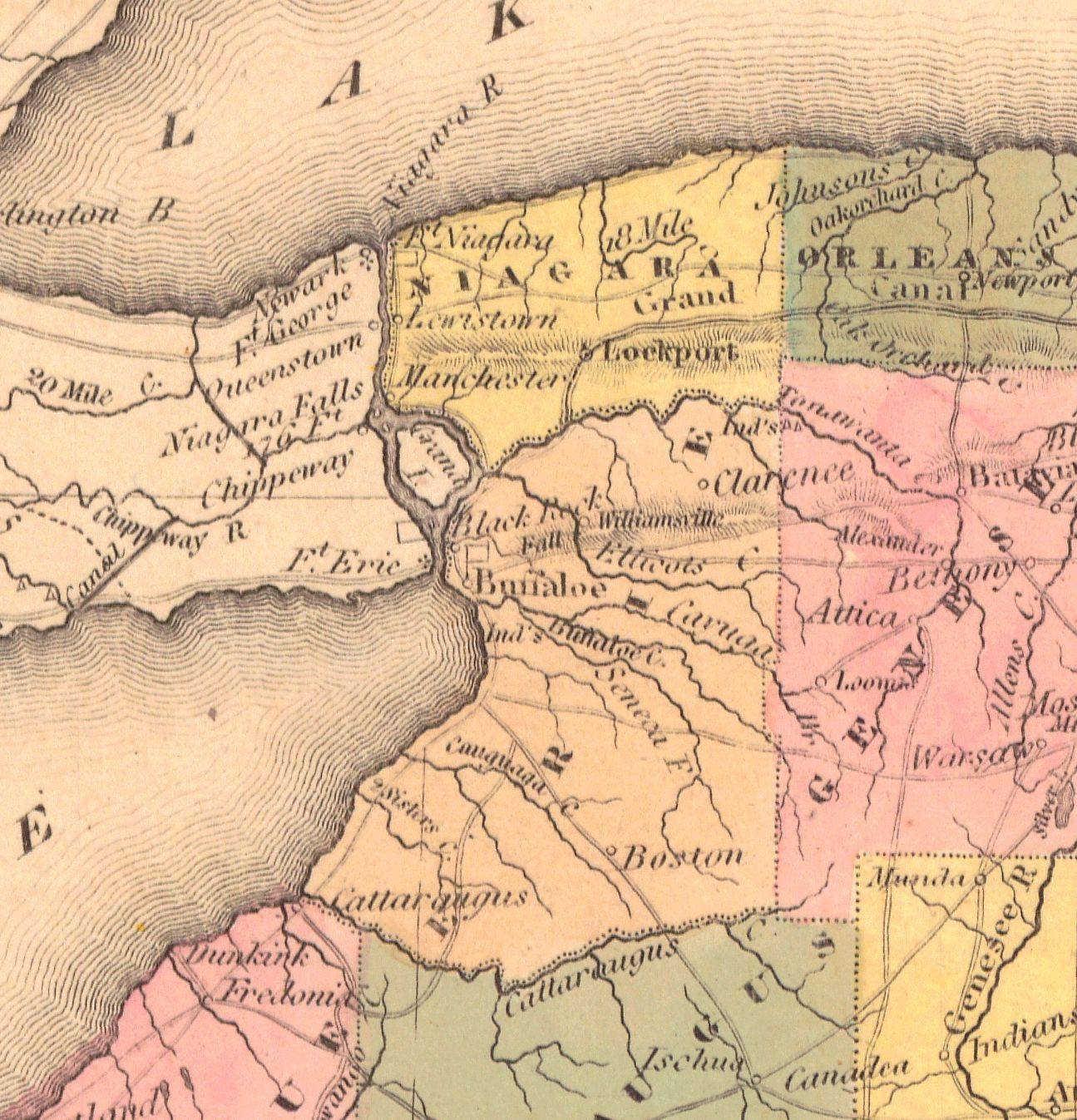
1827 Map of Western New York – Note Prior to the war of 1812 maps called this “settlement” “Buffaloe Creek” and was positioned on the Buffalo River, then after the war it war the new homes were built up higher north of the river and called “Buffaloe”.

Buffalo was growing quickly and by the 1850s its boarder was rubbing against the Hamlet of Snyder and the Schenck’s farm. According to one early source: Timothy Dwight – a traveler in 1804 states the following, “The only villages, which it contains, are Batavia and ‘Buffaloe creek’… Within the [indigenous persons] reservation is included the ground, opposite to Black Rock;… ‘Buffaloe creek’, otherwise called New Amsterdam, is built on the North-Eastern border of a considerable mill-stream, which bears the same name… The village is built half a mile from the mouth of the creek; and consists of about twenty indifferent houses…We saw about as many Indians in this village, as white people… [Since our journey in 1804 ] The ‘village of Buffaloe’ was burned down during the late war. Since that period it has been re-built, and is now a beautiful and flourishing town of one hundred and fifty houses.” Dwight’s observation were published in 1820, a sequel to this publication was expanded with additional information in 1822, “Beyond this hamlet a handsome point stretches to the South-west; and furnished an imperfect shelter to the vessels, employed in the commerce of the lake. Seven of the vessels, (five schooners, a sloop and a pettiaugre) lay in the harbor at this time.” [11]
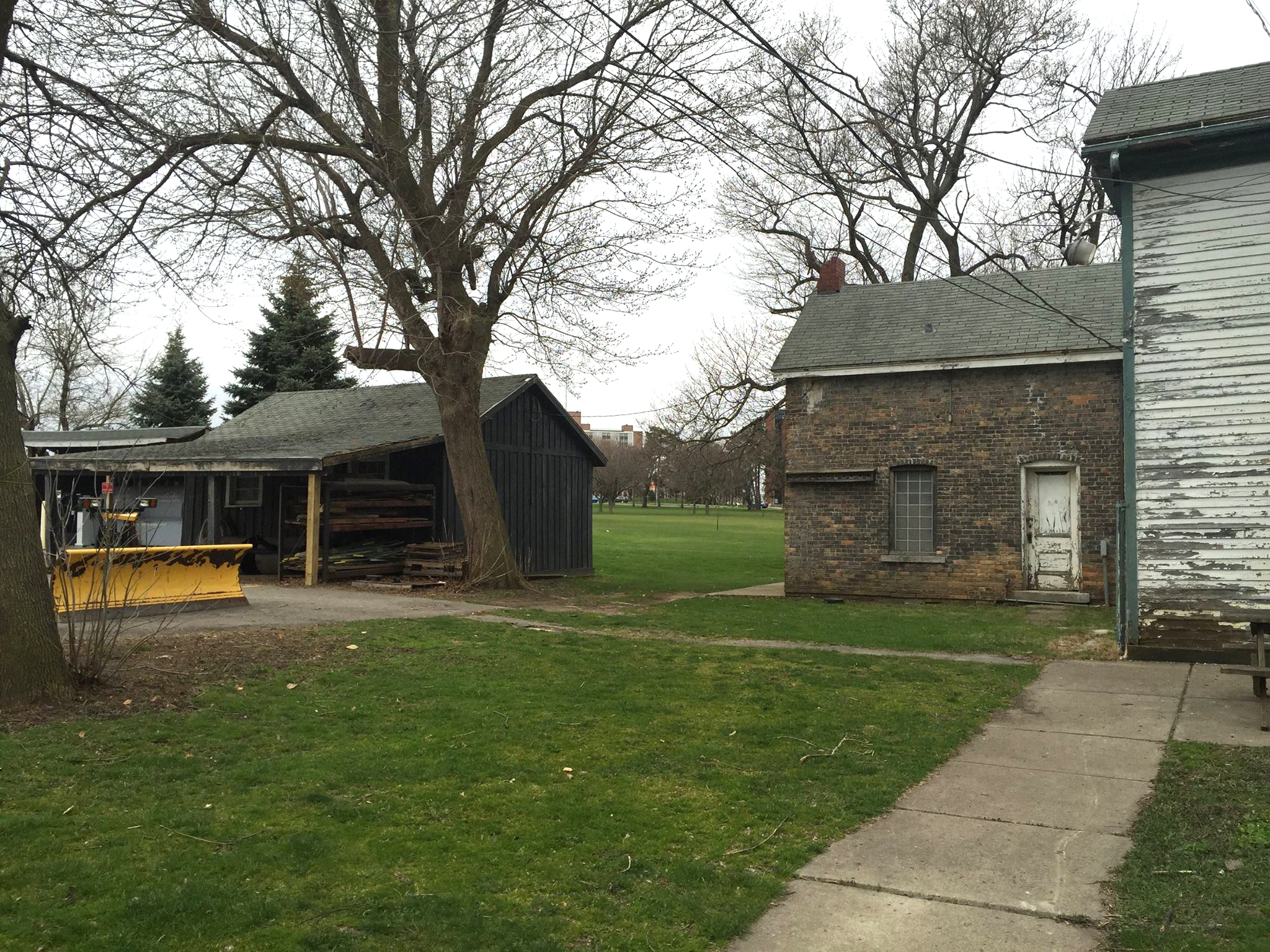
Much of the history that is written for Buffalo tends to focus on the Victorian era, with a portion detailing Olmsted’s work from the 1860s and 1870s. Very little is talked about how “Buffaloe creek” came to be, what it looked like, or how people lived. We have a good sampling of 1830-1860s buildings; Little Summer St. can boast a number of 1830s and 40s homes, the Hadley stone farmhouse is in the Greece Revival fashion dating to post-1830, the Macedonia Baptist Church from 1845 and a few others give us a basic template to build visuals. However, as of today there are only two houses that date from a time when our 5th President James Monroe (1817–1825) was in office; the Coit House 1818 and the Schenck House 1822. 
What is rather exceptional about the preservation of these two houses is that the Coit House is in the Federal Style influenced by British- American fashions and the Schenck House is in a European-American style called “Continental Pennsylvania German House” (CPGH or Continental). The Federal and Continental styles have a number of distinguishing factors with the Federal revolving around fashion and a sense of balance seen from the outside and the Continental Pennsylvanian eschewing fashion for practicality on the inside. 


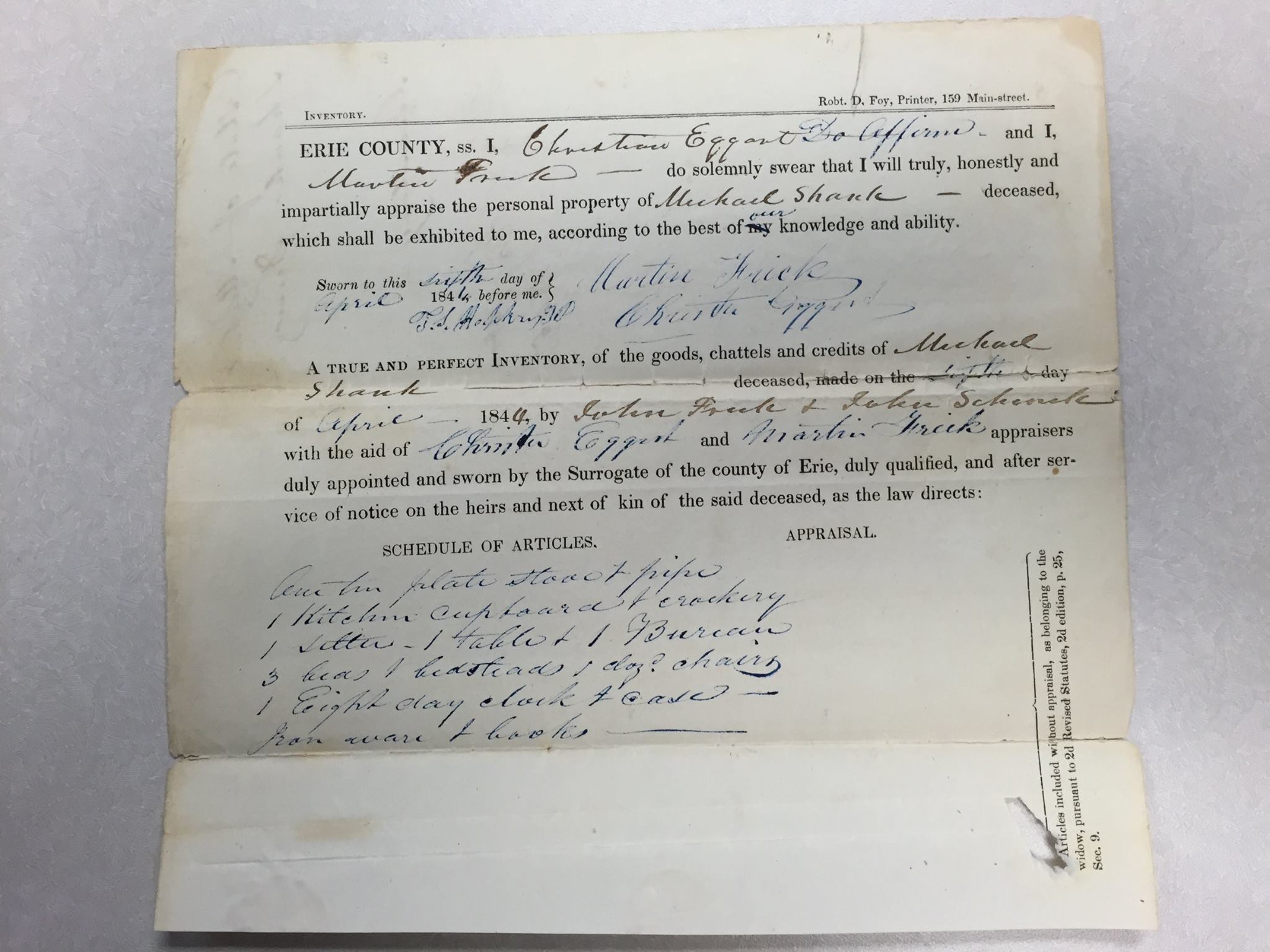
1840s Inventory with 10-plate stove and pipe

The Federal style has a central entrance door leading into a foyer with a floor plan of four rooms over four. Wheres, the Continental style was designed with central heating in mind, as Germans had developed the cast iron heating furnace and stove during the middle ages. With having imported their technology with them to America the houses continued to be centered on the stoves. The houses were arranged with three rooms over three, which off set the front entrance door to one side. The inventory from the 1840s for the Schencks lists a 10-plate stove with pipe in among several other items, a later inventory lists a new coal stove. However, the Schencks did not cook on their plate stove, it was a heater, they cooked out of their fireplace and pot chains are found in their inventory. Most interestingly, the walls of the house are three feet thick in the cellar, and two feet thick at the first floor tapering to the attic. For the Schencks, they were building to last centuries. Unfortunately, after only one year in their new home; first Sarah in the spring, then their two and three year old children passed, leaving Samuel alone.


The Schenck house is one of two examples of homes from the early part of the 19th century within the City of Buffalo limits. The stone is locally queried limestone where fossils can be seen on the southwestern side (rear corner) of the house.

Its never a good idea to leave a widow rambling alone around a big stone house. It appears that one pastor spoke with another and the following year Samuel married Magdalena “Lena”; who lived just the other side of the lake in Canada. Canadians, according to the early census records were as enthusiastic as the Pennsylvanian Germans to move to Buffalo and Snyder. The Town of Amherst had 1,556 Germans and 364 Pennsylvanians arrive by the year 1850, or 43% of the total population. The City of Buffalo had 9,409 Germans, 69 Prussians and 376 Pennsylvanians by 1850, or 23% of the population. On top of this were a conservable number of Canadians and French people. Each census cycle, the Schencks are recorded as having German laborers working on the farm, and were likely bi-lingual. There has not been any evidence of them ever having owned slaves. 
The Schencks were unusual for other reasons too. Being of Continental European heritage, they not only loved central heating, they also brought with them a few other ideas thought both strange and marvelous to British- Americans. These unusual practices included; crop rotation, using manure as a fertilizer, letting land lay fallow to regenerate and the building of structures called barns. The English on-lookers were more amazed when they discovered that these immigrants built these massive barns to house their animals through the winter and even took time to grow hay and feed the animals during the cold months. This system of farming had developed during the later half of the middle ages; served the central Europeans well enough that the methodology persisted and was brought to America. 
“…the Germans differed from practically all other Pennsylvania farmers, with the exception of the few Dutch, in providing shelter for their animals in winter. A traveler of the mid-eighteenth century noted shortly after his arrival in Pennsylvania that cattle around Philadelphia were neither housed in winter nor tended in the fields; after having been in the country for some time, however, he remarked that while the English and Swedes had no stables, the Germans and Dutch had “preserved the custom of their country, and generally kept their cattle in barns during the winter….They kept their animals as warm as possible in winter, and thereby effected considerable savings in hay and grain, for they found that cold animals eat more than warm ones…. the Germans began to build large barns rather than houses. The attention paid by Germans to the construction of barns, which became the envy of the non-German countryside, was brought out by one observer of 1753, who commented that “It is pretty to behold our back-settlements, where the barns are large as pallaces, while the owners live in log hutts; a sign tho’ of thriving farmers….The vegetable gardens were filled with weeds, intermingled with cabbages, turnips, and other plants.” German Agriculture in Pennsylvania, 1959, page 197 [27]
While the Schenck’s lifestyle is easily visualized in part because of their early adoption of technology and their tendency to stick with (what we modern thinkers might call) environmentally friendly practices despite the growing tendency to adopt synthetic fertilizers and specialization; but because, in the Schenck House, the ladies were viewed as partners. The women were producing small batches of products for market including; apple butter, dairy butter, honey and barrels of “graag”. “Graag” is hard cider. It is possibly the only 19th century example in the City of Buffalo where the original site and records survive for a female entrepreneur. 


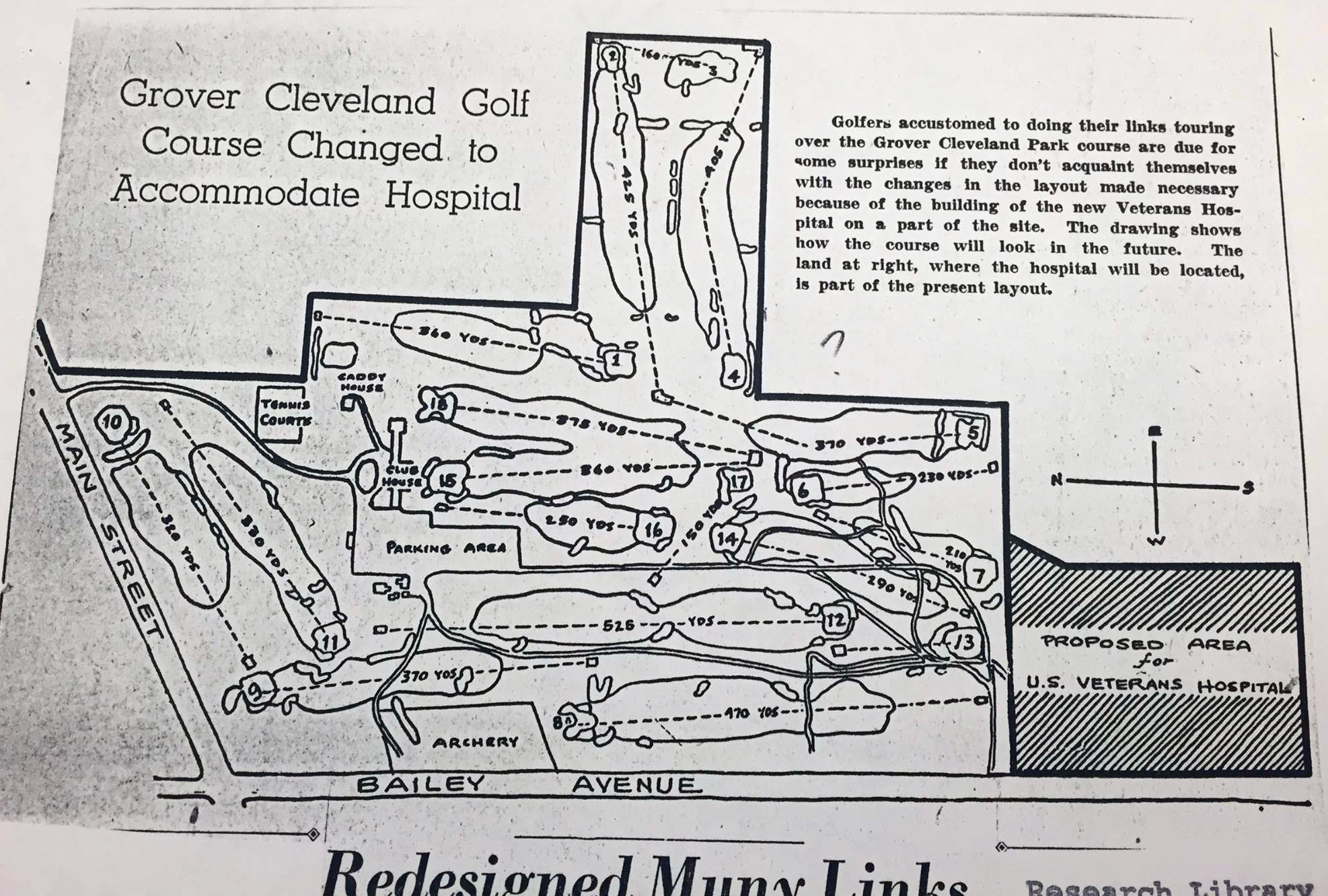
1918 Map of Grover Cleveland Golf Course – Schenck house and barn are left hand side of the central parking lot.

The property was first purchased by the Country Club of Buffalo who installed both a polo field and 18 hole golf course. Then resold to the City of Buffalo in 1927; where on the 1928 survey map we can see how the City promptly drew a bump out to include the farm and 18 hole golf course within the limits. The City renamed the property Grover Cleveland Park and Golf Course. In the 1970s and due to budget constraints, the City turned over the management – while retaining the property title – to Eire County. With ownership in the hands of the City and maintenance and Management in the County’s the Schenck house has survived in part because of the golf course. 
The Friends of Schenck House support Erie County and the 2003 Master Plan to restore the oldest stone house in the City of Buffalo. According to the Master Plan, “Another notable heritage aspect of the Grover Cleveland Golf Course is that the site has one of the oldest stone buildings in Erie County on it, possibly dating back as early as the 1810s. [The 1810 cottage no longer exists] This structure is currently used for limited offices and storage for the golf course operations, and is in need of upgrades to preserve its structural and architectural integrity.” and “Actions prescribed by the 2003 Erie County Master Plan…Consider the inclusion of the stone house and outbuildings on the National Register of Historic Places. Consider a public/private partnership in restoring the old stone house structure and associated out-buildings. Potential exists for a heritage- related museum, restaurant, upgraded golf course-related facility, meeting rooms, etc. Maximize the access and visibility to Main Street, the proximity to the University at Buffalo and the close proximity to some of the region’s most prestigious homes as major marketing advantages for future uses at this facility.” 
Our goal is to get Landmark status, replace the roof which is leaking, complete a restoration plan… and eventually get to the point where 1) the University of Buffalo’s Departments of Anthropology and Architecture can hold field classes on site 2) baking classes can be made available to the public 3) and for all the local brew and drink lovers out there… bring back Lena’s “graag” and install a still. (I’m thinking October Fest !) In this we would put into adaptive re-use a city owned house for the public events and generate on-going cash flow for maintenance of the site. If you are interested in being involved please message us through Facebook. We are looking for people with a variety of talents to lend a hand in bringing back a bit of our history for public use. 
Thank you, The Friends of Schenck House Est. 1822


Wednesday, October 3, 2018

Well Paid Foster Moms - 1665


"...for 35 guilders a month..."- 1665


Women were often paid pretty well for their services. The two women below were paid 35 guilders a month - each - to wet nurse one of a pair of twin babies for one year.

1665 October 27th - "'Lenne' Roebers will, for one year, wet-nurse Kaste NOORMAN ’s child for 35 guilders a month; if the child dies, she will still be paid for the month in which it dies…Fiete Jansz will take care of the other child on the same condition"... and for the same pay as above is explained.

Another  example was of Geurt Kendrick's wife who received f.32 per month.  One more child was fostered for f.30 a month. 'Marytie' 'Claesen' receive f.25 (guilders) per month for keeping a school aged child, plus a one time payment of  f.4.14 in wages for sewing for the child, with the fabric being paid for by the church. These were not the only types of jobs open to women but it is a great example of how women who did not run taverns, shops or own ships were making money.

'Roebers" and 'Jansz'  earned in one year 420 guilders each, Kendrick earned 384 guilders, another earned 360 guilders and Claesen earned 300 guilders. Once the babies were weened the wage paid dropped little by little according to the work load associated with a more capable child.

The child kept by Marytie Claesen was attending school, with the school master being paid 17.8 guilders, but for an unknown duration. There are a number of payments going out to people we can use for comparisons. Mister Cornelis van 'Dijck' received 200 guilders a year from the church for heeling the sick. But this also assumes he took on personal clients.  Jan Peitersen was paid 5 guilders for 1 4/5 day's worth of mowing (grains). A Native American earned 10 guilders for diving into the water and finding a lost yawl from a ship, A man named Tobias was paid 2.10 guilders for a deer. 'Dirck' the mason for 10 days work at a chimney 10 guilders.

For Jan Peitersen, if he was earning roughly 1 guilder per day, that is about 20-24 guilders a month during harvesting. Harvesting occurs regularly due to rotating crops. 'Dirck' the Mason was earning about the same 10 guilders for 10 days work, which I assume was discounted for the church. In essence, women fostering children until they were about 14 years old which is when they were apprenticed in New Netherland and New York, means the ladies were earning a fair sum of cash in 1665 and 1666. However, the year is a problem... it was the first and second year that the English had gained control and pricing was probably not reflective of better times. But it gives us a good idea of what people were paid even under duress and limited economics.

Master Reyn received 18 guilders for repairing a ship's yawl and 15 guilders for building a (small) boat. Abraham Page the Englishmen received 12 guilders for 8 days of haying, and another 6 guilders for 4 more days of haying. A more consistent income to compare the fostering moms to is Ariaen the Servant who received "5 months wages at fl. 150 a year" 62 guilders. Except servants also had their room and board covered. Nevertheless even if we doubled the servants income to 300, it is at the low end of what a foster mom makes.

'Hubert' Jansen earned  8 guilders a year per person for doing their laundry. He would have to do a ton of laundry to make what a foster mom makes. However, he received a new contract which was 31 guilders a month to care for an old captain including board and laundry, or 372 a year. Another good example of ordinary people's income is a shoemaker's assistant which would be a contract for 2-3 years. In one instance an adult assistant in Albany was under contract for 10 shoes per day in summer.. possibly less in winter with shorter day time light ... received 120 guilders per year. Again, room, board, and laundry were included, but that is less than a servant and much less than a foster mom.

120 Shoemakers Assistant
150 Servant
200 Part time Doctoring for the church
300 Fostering school age child
372 Elder Care
384 Non-Nursing child under about 7
420 Wet nursing


So what did 300 to 420 guilders buy a person in the mid-1600s?

From the same 1665/1666 accounting book we can see the following recorded in guilders.

1 schepel of grain cost 7.10 [45 pound of wheat]
1 schepel of corn cost  6.0 [42 pounds of corn]
? "pumpkins" cost 6.0
2 schepels of rye cost 5.0
2 pounds of butter cost 3.0 [32 ounces]
2 pounds of fresh meat 1.8 [32 ounces] 
 1678 Albany (Supplemental data)
6 schepels of peas equals 1 beaver [= 8 guilders/6 schepels or 27 'stuivers'/schepel/45 pounds ] 

Note that: 1 schepel = 3/4 bushel. One bushel = 60 lbs. of wheat, 56 lbs. of shelf corn, 60 lbs dried peas. And a modern person eats between three to five pounds of food per day.

Let's say we bought 1 schepel of wheat, 1 of corn, 1 of peas, 2 lbs butter, and 2 pounds of fresh meat or 136 pounds of food. That would be 4 pounds of food per day for 31 days and it would cost about 21 guilders and 45 'stivers' or 23 guilders 5 'stivers'. With keeping in mind that carrots, lettuce, parsley, sage, turnips, apples, pears and cherries were items commonly grown in the yard. If roughly 2 pounds of food per person per day was coming from the yard, then the additional 4 pounds of food we purchased could bring a family of four to three pounds of food per person per day. It is on the low end, but hunting was common and meat was rather cheap at 2.10 guilders per deer. Especially considering the hide - even undressed - could be sold to offset the cost. Plus there were fishing poles and clam rakes. 

1665/1666
2 pounds of soap cost 2.10
1 pound of candles cost 2.5
a broom 0.12
Laundry Service for a year 8.0

Assuming we need soap and candles each moth and to budget for the mending or braking of household items we can add another 4 guilders 27 'stuivers', for 27 guilders and 32 'stivers' or  28 guilders 12 'stuivers'. Interestedly, regular laundry for one year cost 8 guilders, or 160 'stuivers' per year or 13 'stuivers' per month. Laundry services were common so let's add that in... 28 guilders 25  'stuivers' or 29 guilders 5 'stuivers'. 


Could you live on Foster Care Income? 

Foster care provided a considerable addition to the household income. Especially since the church would cover all clothing and education costs for the child. For the shoemaker's assistant, their room, board and laundry was included in their contracts with the 150 guilders a year being for clothing, tavern, savings and fun. Foster care could care for one person well enough assuming they rented a room for 8 guilders a year, or significantly raise the standard of living for a family of four, if there was another adult income. For a laborer who mowed wheat or the mason who was doing a lot of discounted work for churches, his wife's income could make a world of a difference. Assuming there was a typical Low Countries style garden, her income could keep the family fed and with candle light allowing his income to cover rent, clothing, and other goods or tools. A foster mom is essentially covering all the day to day cost of the family with room for some extras such as 2 pairs of shoes at 10 guilders, two new copper kettles at 16.16 plus a few extra left over.  Alternatively, she could order two new full sets of clothes (jacket, long sleeved under shirt, fabric breeches, leather breeches, shirt, drawers) for her own children at 36 guilders. 


Food, soap & candles = 29 guilders 5 'stivers'/month (348 guilders 60 'stivers' / year). 

300 Fostering school age child
372 Elder Care
384 Non-Nursing child under 7
420 Wet nursing

With this in mind, reenactors looking to portray "ordinary" people may take into consideration duel income families and other "hidden" cash flows not always obvious in history records like the selling of venison on the side. This would greatly affect the goods they could afford. For ordinary people of the Province, how to spend the extra cash would vary. One may choose to sleep on coarse linen but buy a Holland linen shirt, while they may have iron pans, they may pick up a few copper kettles or have serge suits as their best suit but always new shoes.


* If you see a mistake in my calculations let me know. I used a 20 'struiver' per guilder conversion rate. 


Below are some additional prices:

Other Goods: Note that "f." = guilder

In 1658 Jan Justen paid for 20 ells “coarse” linen f. 20, 4 pairs of shoes f.20, 5 pairs of stockings f.15, 20 ells of duffel f.80, 2 blankets f.32, 4 ells of cloth f.36, 2-1/2 ells of duffel f.20, “N.N.” 2 kettles 7 lbs f.16:16 
In 1661 sent to NewAmstel:
Nelis” “Laersen” 1 pair of stockings [guilders] 3.0 & 2 pairs of shoes [guilders] 10.0
Thomas “Hoppens” 1/2 alm anise (anis) [guilders] 140.0 & 3 ells red duffel [guilders] 3.0; “Baes” “Joosten” 1 large earthen jar f. 4 
Sold at Auction at Fort Orange 1666
a leather and a cloth breeches [guilders] 36.10.00
2 pr woolen stockings [guilders] 14.15.00

Cost of clothing children:

2 pairs of shoes for children 9.0
1/2 ell serge for [1] child's [2] caps 2.0
7 ells of linen for [1] child's shirts 15.0
3 ells of red baize 24.0
2 pairs of stockings 14.0
2 3/4 ell of blue linen for diapers 13.15

For a full set of clothing we have the following quote:

Frans Coninck’s children 2 packages of underclothes on which was used 5 ells of white baize…Frans 2 packages of leather clothes, on which were used 7 deer skins, 2 ells of Osnabruck, Frans a ape rock and a borstrock on which was used 3 ells of kersey at 12 guilders the ell…f.36.

Saturday, September 8, 2018

Getting Dressed in 1665


This is great video of how to get dressed in Delft, Netherland. There are three primary sources in New Netherland and New York with the outfit she is wearing in particular this specific bodice that had a boat neck and worn to be shown. See article here with primary sources.

Enjoy the video !

Tuesday, August 28, 2018

Japanese Kimonos in Colonial New York


"1 blew silk Japon men gowne 02:10:00" - 1685 NYC


If you are a reenactor looking for something different or are a bit baffled by the fact that many types of men's and women's robes are listed under the generic term "dressing gown" or "night gown"  or more appropriately "chamber robe" we can use primary sources to determine what the variety of robes really were. 

One thing to consider, is that the 17th Century bridges the middle ages to modern era, so when thinking on how a person perceived themselves and the world the 1600s really were a blend of the 1500s and the 1700s. The microscope and telescope were newly invented, bayonets were mostly being used by French armies and not widely en vogue instead there were pikes and snaphaunces, and meat became something people had weekly. The Dutch discovered every possible broom and brush for cleaning the home and developed the idea of washing one's clothes each week. The western world discovered coffee, tea, lettuce salad and this thing called a fork from Italy and tiny tea pots of red clay from China. Then they wrote about it in several "Discovering the world" books and published maps of near and far off places, both of which were exceedingly popular because half the population could read. The Discovering the world books always include a description of clothing, not just the jacket or robe, but even what they wore under their clothes... every piece. The Dutch were curious, exacting... and likely got nipped in the nose a few times.  

With people being able to read about these lands and find them on a map, their desire to own goods from these places were the next step. Interestedly, an item like a Japon robe does not reveal much of the body. The emphasis was not if he looked masculine, or if she had a tiny waist, it was about the person. And apparently, clothing that emphasized the person was popular. Some call it a Golden Age; it really was a Sophistication of the curious mind, an escape for one that loved reading about people both next door and in far off lands. 


Robes: 

There are actually four different terms that get grouped under "chamber robe" when using 18th Century references; the Banyan (Bannian), Japon rok (Japonsch rok), the Turk and the Muscavoy. However, in the 17th Century they are identified by the nation they originate from. There is also the Sultan which crops up for men in the 17th Century, then falls to the side, and reappears in feminine form in the 18th Century...but I have yet to have found these in American docs. 

Of the five robes mentioned, the Japon rok, Turk and Muscavoy are worn during both the 17th and 18th Centuries in New York and New Netherland. For those 17thC reenactors preferring a fitted garment like the Banyan, consider a Muscavoy coat which is a similar fit and length but with parallel horizontal frogging down the front. You probably have seen them in paintings. Or a Turk which has fitted sleeves and wrap front. The Sultan has wide sleeves like the Japon. We can circle back to these other robes. 


In dictionaries: 

1766 - A Large Dictionary English and Dutch: in two parts - "“Ro’k, a coat, gown. (next) een Japonsche-rok, a chamber-gown." 


 1766 —-Volkomen woordenboek der englelsche en nederduitsche taalen, by William Sewel, Egbert Buys, Caspar Philips - "A morning gown, Een nagt rok, japon."

1707 - A Large Dictionary English and Dutch,: In Two Parts by the Englishman Willem Sewel, “JAPON, Japonse rok, a Chamber gown."


In Early Documents: 

1690 - Europische Mercurius behelzende al het voornaamste 't geen in ..., Volume 1
By E.V. V. "...that was the end of justice. The Elector went beforehand, with the principal Ladies, at one end of the Hall, where after his Seal, regal thoroughness, with a long Japanese dress, was done..."

1669 - "Gedenkwaerdige Gesantschappen Der Oost-Indische Maatschappy in 't Vereenigde ..." By Arnoldus Montanus 


Were there other items from Japan?

Yes. Japanese stilyards, a type of scale, are common in most any inventory where someone sold groceries, sugar, textiles,... anything. Sometimes, a person (men and women) didn't sell anything and there are large and small stilyards in the same inventory. The small ones can be carried in a bag they are so small and good for purchasing small personal size amounts of tea or sugar. There is a Japanese cutlas. There are also Japanese quilts, compared to ones from India. Plus, lacquered chests small and large. Plus, the type of pant worn with the Japon were also imported. Much of this is due to Wina van Hoorn who imported goods from the far east, but also from India. 


Side note: 

The term Ban-nian/Ba-nian is the original word and used in both the 17th and 18th Century. Bannian and Banian continue to be used in the 18th Century but the spelling "Banyan" is introduce in 1728. I am guessing that the spelling used for "Banyan" may be an English colloquialism. The original using the /a/ as in / ball/, instead of the American short /a/ sound. 


In 1641 the first Japanese kosode are shipped to Amsterdam: 

In 1641, The supreme leader of Japan was the Shogun who gifted 53 of these silk robes - 23 were black - to seal the trade deal with the Directors of the Dutch East Indies Company. These robes are not really kimonos. The kimono starts off as the kosode in the 17th Century, and developed from here. [koe-soe-day]  Wiki Commons Kosode Image. For the record, Japanese use the European pronunciation of vowels. 


1675, Netherlands, Anna Elisabeth van reede. 


The Kosode in the Netherlands:

The Dutch were not irreverent to the importance of the gift that they would use it as a dressing gown but instead they were worn to work which is why during the 17th Century they are often painting while the sitter is at a desk in front of a book. They were also called a "night gown" not to be confused with a dressing gown. 

In the below two images the similarities of shaping can be seen. Both happen to be printed in 1669. 

1669 - Portrait of Amsterdam predikant Conradus Hoppe, by Jan Veenhuysen


1669 Likely a Japon but could also be a "Sultan", of Daniel Bernard from Museum Boijmans Van Beuningen is on loan at the Amsterdam Museum. 


Due to the early date of the image above, it is likely an original "Japon Rok" (Rok = Dress) which would be worn over a skimpy double or waistcoat instead of a jacket or coat. When I did a year long study aboard in Japan, my professor told the class that the word "Japon" and "Japan" is a Dutch invention. It is possible that the Dutch heard Ji-pon or Ja-pon when the Japanese introduced themselves as "Ni-hon-jin" and referred to their nation as "Ni-pon". And truethfully to western ears, /ja/ in Japanese [Nihongo] really does sound similar to /ji/ in the same away that /p/ and /b/ or /m/ and /n/ can be mistaken in English. 


Were there Japon Robes in America? 


There are defiantly a number of them as they are called such by name, Japon rok or Japon robe plus the paintings ! There is another robe, that we can tell is a Japon because it was "padded" as described in Dutch: 1693, Albany, a night "rok" with padding. We can include this because the inventory was written in Dutch with the exact same terms being used in the Netherlands for the same time period. A Night dress in the Netherlands is a robe worn over clothes in place of a coat or jacket. This particular robe is listed with the petticoats. 


A 1685 NYC probate inventory has, "1 Japon Coate lining with 'redd' say 01:15:00". This robe was possibly a Dutch or domestically (American) made Japon coat as say was not a textile of Japan. However, the "1 blew silk Japon men gowne 02:10:00" and the "1 ditto 'redd' 02:10:00 that were for sale in an East Indies store in 1685 Manhattan are highly likely imported Japanese kosode. This same store also lists a number of flowered "India jackets" so we can see that this is not confusion on the part of the author's, who happened to be the owner of the shop. In 1686, the Mayor of Albany owned 2 Japon robes. 


At one to two pounds it was not a robe within "every" person's means, but it is comparable to other clothing. As can be seen, one silk Japon is worth about one man's suit or a woman's scarlet petticoat and Samare from a squarely middle class couple's wardrobe. Alternatively, the domestically made one is the same cost as a Jacket. A colonist could have two sets of waistcoat and bottoms and wear a jacket with one and a Japon with the other. 


1685: 1 black “gross” “greaine” “suite” [men's] 02:17:00, 1 "Indea" "petticoats" with body of "redd" bay 00:17:00, 1 ditto [woman's Indea petticoat] Scarlett 01:15:00, 1 flowered calico petty coats with "redd" lining 00:16:00, 1 colored "stuff" Samare [woman's pleated back coat] 01:10:00.


Japon robes during the 1640s - 1660s were owned by mega merchants or directors of the Dutch East Indies company. By the 1670s, enough had been imported that not only magistrates, but also clerks, scientist and even artists and musicians were wearing them. Women merchants and shopkeepers also sported Japon robes. It was a very continental thing to do, and signaled to everyone that you had a love for exotic cultures and goods. 


The PAINTINGS ! 


There are a few of them, most of which show women wearing them. The upper portrait: This is one of the most beautiful, the sitter is unknown though from New York and the painting is attributed to Gerrit Duyckinck c1660-1710. The lower family painting: Below is a painting of the Emmanuel de Witte, Family Portrait, Munich 1677 with a daughter in similar Japon. It is likely that our unknown sitter is painted about 1690 due to the gown, fan, hair and also the front lacing stay. (There are a couple early inventories that mention having a painting of their daughter, that with further research it may be possible to narrow who this person is down to 1 or two choices.) Because there are no stays for children recorded in 17th Century inventories except out on Long Island, I would say she is over 14 years old and likely closer to her late teens. Her clothing shows her sophistication as she choose a garment from Japan rather than other styles, her stays were attractive so instead of a stomacher she showed the lacing. This is common among Central Europeans. Her fan, again, is a fashion statement, on trend, and nothing more. The flower however, may have some significance beyond giving her something to hold, but it is important not to read too deep. Her hair being down is also common in New York for woman, and should not be read into. Visitors comment on the simple hair styles of New Yorkers, and their "spritely" attitudes. 


The below image is of Deborah Glen, attributed to the Gansevoort Limner, and is in the Colonial Williamsville collection. Note that the pattern on the sleeve is perpendicular to the pattern on the dress when the arm is at rest. There is a hard date to the painting of 1739 in or near Albany, NY. It is difficult to know if the center front of the robe is sewn shut or is just overlapped. However, an English visitor remarks on another Albany family as wearing the same outfit, a wrapping style robe flowered over a petticoat. They also mention the people of up-state NY having their hair not up... but down and simply in a tie like the painting. The visitor mentions this was daily attire for women whether a teacher or student, as much as it was to play shuttlecock or chest. Apparently, normal pastimes for NY women. 

What is interesting is that Glen choose a traditional robe to be painted in with contrasting lining that had been in fashion in up-state New York since the late 17th Century and originated in the Netherlands. Her pierced ears are another traditional refinement that has been fashionable since the 17th Century in New York. I think there is a tendency to mistake her garment as being "rich" or of a "wealthy" class.. but by 1700 this style of robe was typical of educated people as much as it was of artists, musicians and shopkeepers. I think it speaks to both cultural tradition and worldly sophistication. What is fashion forward is her use of a Central European stay, which you glimpse where the lacing crisscrosses in the center front. This was on trend in culturally Germanic regions, and New York, and the shortening of the sleeves which started in the 1720s. It was common for Dutchmen to present their betrothed with a ring of engagement, usually with a small stone in it. It seems Glen has one as this painting occurs right before her wedding. There are a couple early reference to roses and wreaths, with the first from a book looking at the errors of people. 

This gown, along with the Turkish robe will dominate fashions in New York from about 1700-1740s and possibly through the F&I war (1763). 


1668 - "...And also tolerable, if we (wishing that our words are kept closed under the Rose), there are also bad people in company and at the beer bank; In the old habit of wearing rose wreaths in guest rooms, and in this manner, we do not speak of the custom (who is the High-German), who paint a rose in the button [?] on the table. But it would be more significant if it were as original as Lemnius and other written books, that the Rose was the Flower of Venus, which Cupid Harpocrates, the God of silent temperament, had tolerated;...
" - "Pseudo-doxia epidemica, dat is: Beschryvinge van verscheyde algemene dwalingen des volks,..."


The painted flower may reference the idea of a Rose by any other name by William Shakespeare. A 1740 reference to how to paint wreaths of roses or flowers states "... and although every flower has its own name, shape and color, it is not considered, however, in general, that is to say, as under the name can flowers." - Book, "Groot schilderboek, waar in de schilderkonst in al haar deelen grondig werd onderweezen, ..."

If we look at the use of the rose, and the fact that Glen was about to be married, the roses simply represent love.


Mr. Livingston: 

One of the most interesting paintings of an early American is of Robert Livingston (1654-1728), Lord of Livingston Manor who was of Scottish heritage. This is because he was politically on the side of the Governor and is painted with a whig styled in the English fashion and a cravat. However, his whig is brown which was typical color worn by the Dutch and Continental colonist rather than white as preferred by England. This is something that can be seen in paintings but was another observation by visitors. The other blaring issue is he choose the most common color Japon robe used by Dutch Magistrates back in Amsterdam to be painted in. But why? The first Samurai Japon robes were "reddish", brown or black and usually lined in the same color. Though, a more fashionable Japon was with contrasting color lining and had become trending by the time of this painting. It is as if he is giving tribute to both the English governor and the other Dutch and Continental merchants he had to live and work with. 

Merchant: Robert Livingston (1654-1728), Lord of Livingston Manor, New York. The Painting was likely made while he held office 1715 – 1728. - Note how Livingston's hair is brown like the other Dutch paintings but parted at top and the style more structured. And that he points and holds his robe like the Dutch paintings specifically one painted by Caspar Netscher (1639 - 1684) . In most paintings the wearer has to use one hand to hold the Japon closed, however, when painted in genre the Japon is held together with a sash.


Scientist: Portrait of Anthonie van Leeuwenhoek, Natural Philosopher and Zoologist in Delft, Netherlands, Jan Verkolje (I), 1680 - 1686


Doctor: David , Agneta en hun dochter Catherina Neufville - Michiel van Musscher (1645 - 1705), below is an example of a padded Japon... it should have a quilted feel. 


In the End: 

The Japon robe when appropriated by the French is so popular it will be the first on record as being downgraded to a chamber gown from its standing as a robe for Samurai. It is possible that the French had no idea of its importance having adopted the fashion through the Dutch, though they are aware of the original name, Japon. 


There are about eight paintings of New York woman plus Livingston's with a Japon, plus another six in personal inventories (that do not line up with the paintings unfortunately) and another two in a store for sale. It is a robe that could easily be worn for reenacting from the 1650/60s to at least the end of the French and Indian war 1763. New York will never really leave their interest in Japan on the table, paintings by artist will show women in both kosode and later kimonos for some time to come. 


Musician: 


Französischer Meister:


Johannes Hudde (1628 - 1704), Michiel van Musscher, 1686, This one is flowered and padded:


1710 - La diseuse de bonne aventure | Jean Antoine Watteau (1710), And an extend Italian Japon from 1710-1720 made of Lampus comes with blue cap of same material and Caspar Netscher (d. 1684) - Portret van een man in Japanse mantel. 


2 Paintings attributed to Caspar Netscher (d.1684) - Sold at Auctions


This one below in black is one of the most rare types of kimono, due to its color, also by Caspar Netscher (d. 1684). 


The sense of self in the Netherlands and personal identity was not just identifiable at the elite end of the spectrum, but people throughout the middle class which includes the working class were expressing themselves in new and novel way. They were completely adopted foreign garments and using them in a similar way their were originally intended. So, the next time you see a loose robe with no buttons and someone calls it a "dressing gown"... explain it is worn over a waistcoat and bottoms instead of a coat so one may be comfortable while at work, reading, composing music, painting or simply... as a clerk staying up all night trying to get the accounting finished before the shipment arrives the next day.


The two images below don't belong together but have similar coloring and patterning. 


Upper photo: Caspar Netscher, Dutch, 1639-1684, Portrait of a Gentleman, 1680


Lower photo: Silk, gouddraad, Foto: Rijksmuseum Amsterdam, 1689-1702