Showing posts with label history. Show all posts

Sunday, October 21, 2018

Saving the Schenck House

Did you ever feel so passionate about something that you verge on obsession ? The last few years have taught me that everyone has different priorities and roll models. For me, the family that lived in the Schenck House of Buffalo are my roll models. They were good people, leading good lives, with priorities placed on family and practicing farming the way they have since they arrived in America in about 1704. 

I normally do not post about things outside of the time frame of 1600-1763, however, the Old Stone House of Buffalo New York could use our support. I am asking if all of you could help reach our goal of 12 letters of support to landmark the building. The hearing date is this Tuesday! And the best part is that the city is accepting letters via email ! We have literally 24 hours to make this happen, please help.

Thank you more than you could ever know, Tara


Letter of Support:

Cut and paste - The following letter to the Legislation Committee to show support for landmarking the Shcenck House. This one or one in your own words would go along way to show support. Our goal is 12 letters. We have only 2 days to accomplish this goal before the application is processed and they decide to decline or approve it. 

Email: chawley@city-buffalo.com.

Dear Legislation Committee, 
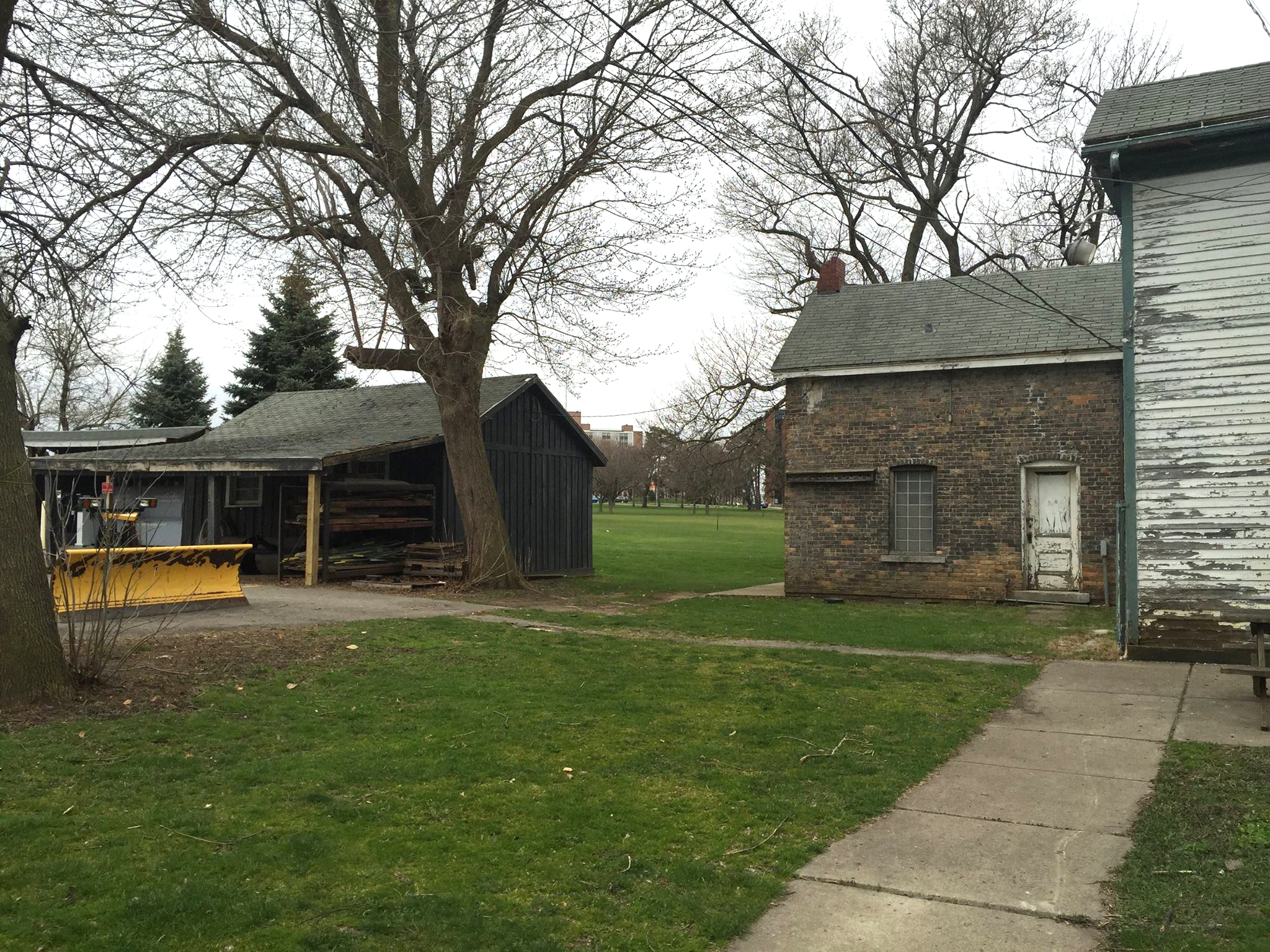
Please approve the request for landmarking the Schenck House, which was built by a father and son team in 1822. The Schencks were pioneers and understood the value of traditional farming methods that were in sync with the environment. They were a family that believed in "share and share alike" whether the child was male or female as recorded in their wills. The little brick summer kitchen is the site of the oldest surviving apple butter, cider and hard cider mill in western New York and happens to have been ran by a woman. They are role models that modern people can relate to. 
Sincerely,


Here is the link to the Schenck House  wiki page that I wrote and an article I wrote about it on Buffalo rising.com


Dear Readers of Buffalo Rising, 
The view from the front porch is through towering trees out across acres of lawn where at the horizon the sun is setting with magenta illuminating the sky. The oaks and maples frame the perfectly kept grass, where local golfers have plays for over a hundred years. The Schenck house has stood here watching over its golfers, and providing loving reminder of our past. Few people have noticed the two story stone house sitting in the middle of the park except the locals, many wondering just how old the place is. Golf carts buzz by, but one stops, “Are you here to save the old stone house?” My colleagues and I smile, “We’re going to try.”
The City of Buffalo was only a village and the hamlet of Snyder a couple of farms when the Schencks loaded all their belongings into two conestoga wagons. They first arrived in America between 1702 and 1709 and lived for a 100 years in Pennsylvania farming their land in the traditional ways of the Germans; but with the opening up of new land for sale in Western New York they were packed and ready to make their way to their new home. With Michale and Catherine Schenck steering a team of four horses and a water tight Conestoga wagon of young children and their eldest son Samuel and his wife Sarah the other, they set out across the Allegheny Mountains in 1821. 
“Michael Schenck emigrated from Pennsylvania in August 1821 with his family in two large covered wagons, drawn by four horses, came by way of Pittsburgh, over the mountain to Erie, thence to a point then called Comstock’s, eight miles from Buffalo, where he was compelled to place eight horses to one wagon, in order to get to Buffalo on account of bad roads, he settled in Amherst, and purchased one-half section of land at fifteen dollars per acre, near Snyder post-office, then heavy timber land.” [10]
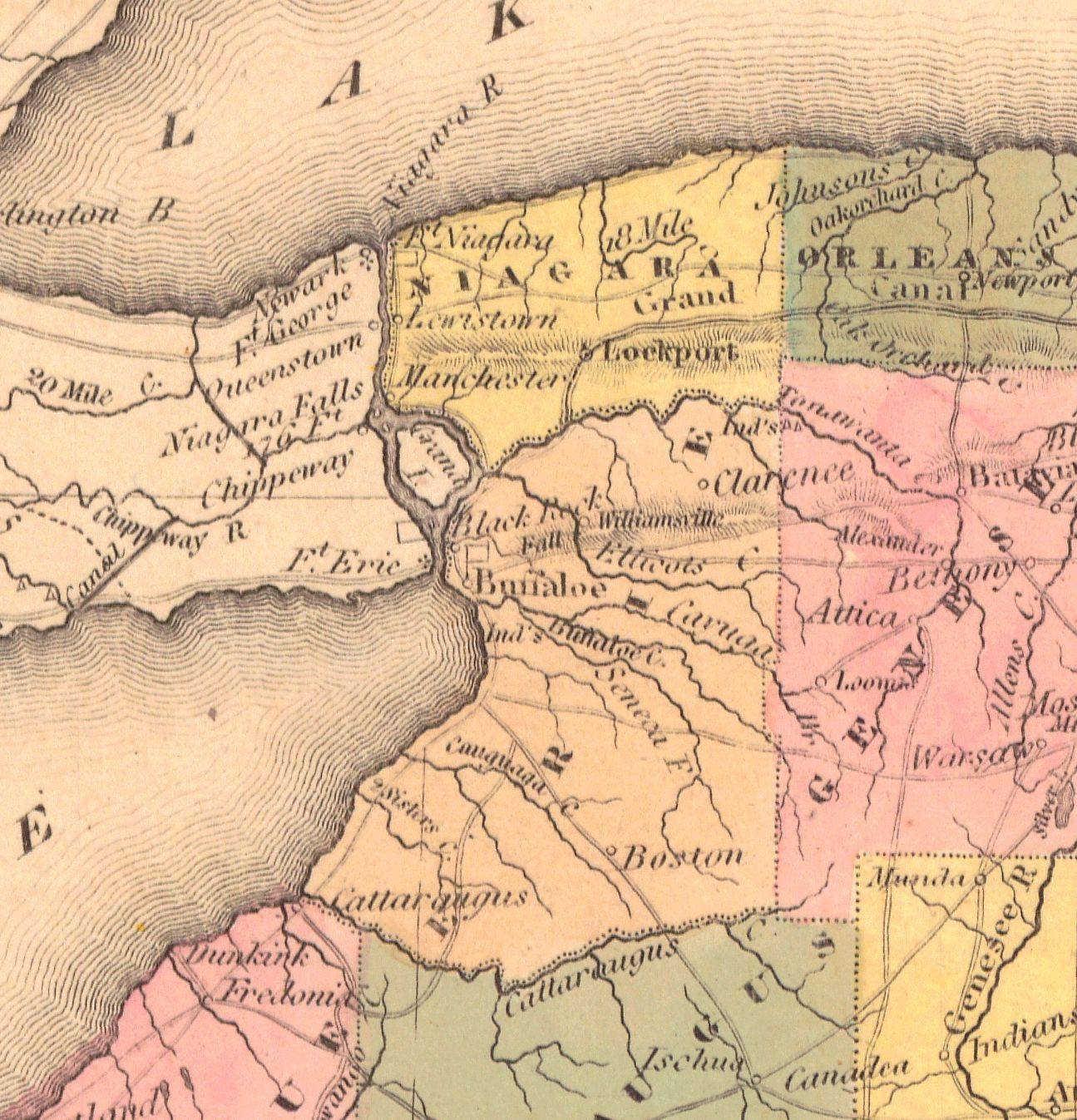


1827 Map of Western New York – Note Prior to the war of 1812 maps called this “settlement” “Buffaloe Creek” and was positioned on the Buffalo River, then after the war it war the new homes were built up higher north of the river and called “Buffaloe”.

Buffalo was growing quickly and by the 1850s its boarder was rubbing against the Hamlet of Snyder and the Schenck’s farm. According to one early source: Timothy Dwight – a traveler in 1804 states the following, “The only villages, which it contains, are Batavia and ‘Buffaloe creek’… Within the [indigenous persons] reservation is included the ground, opposite to Black Rock;… ‘Buffaloe creek’, otherwise called New Amsterdam, is built on the North-Eastern border of a considerable mill-stream, which bears the same name… The village is built half a mile from the mouth of the creek; and consists of about twenty indifferent houses…We saw about as many Indians in this village, as white people… [Since our journey in 1804 ] The ‘village of Buffaloe’ was burned down during the late war. Since that period it has been re-built, and is now a beautiful and flourishing town of one hundred and fifty houses.” Dwight’s observation were published in 1820, a sequel to this publication was expanded with additional information in 1822, “Beyond this hamlet a handsome point stretches to the South-west; and furnished an imperfect shelter to the vessels, employed in the commerce of the lake. Seven of the vessels, (five schooners, a sloop and a pettiaugre) lay in the harbor at this time.” [11]
Much of the history that is written for Buffalo tends to focus on the Victorian era, with a portion detailing Olmsted’s work from the 1860s and 1870s. Very little is talked about how “Buffaloe creek” came to be, what it looked like, or how people lived. We have a good sampling of 1830-1860s buildings; Little Summer St. can boast a number of 1830s and 40s homes, the Hadley stone farmhouse is in the Greece Revival fashion dating to post-1830, the Macedonia Baptist Church from 1845 and a few others give us a basic template to build visuals. However, as of today there are only two houses that date from a time when our 5th President James Monroe (1817–1825) was in office; the Coit House 1818 and the Schenck House 1822. 
What is rather exceptional about the preservation of these two houses is that the Coit House is in the Federal Style influenced by British- American fashions and the Schenck House is in a European-American style called “Continental Pennsylvania German House” (CPGH or Continental). The Federal and Continental styles have a number of distinguishing factors with the Federal revolving around fashion and a sense of balance seen from the outside and the Continental Pennsylvanian eschewing fashion for practicality on the inside. 
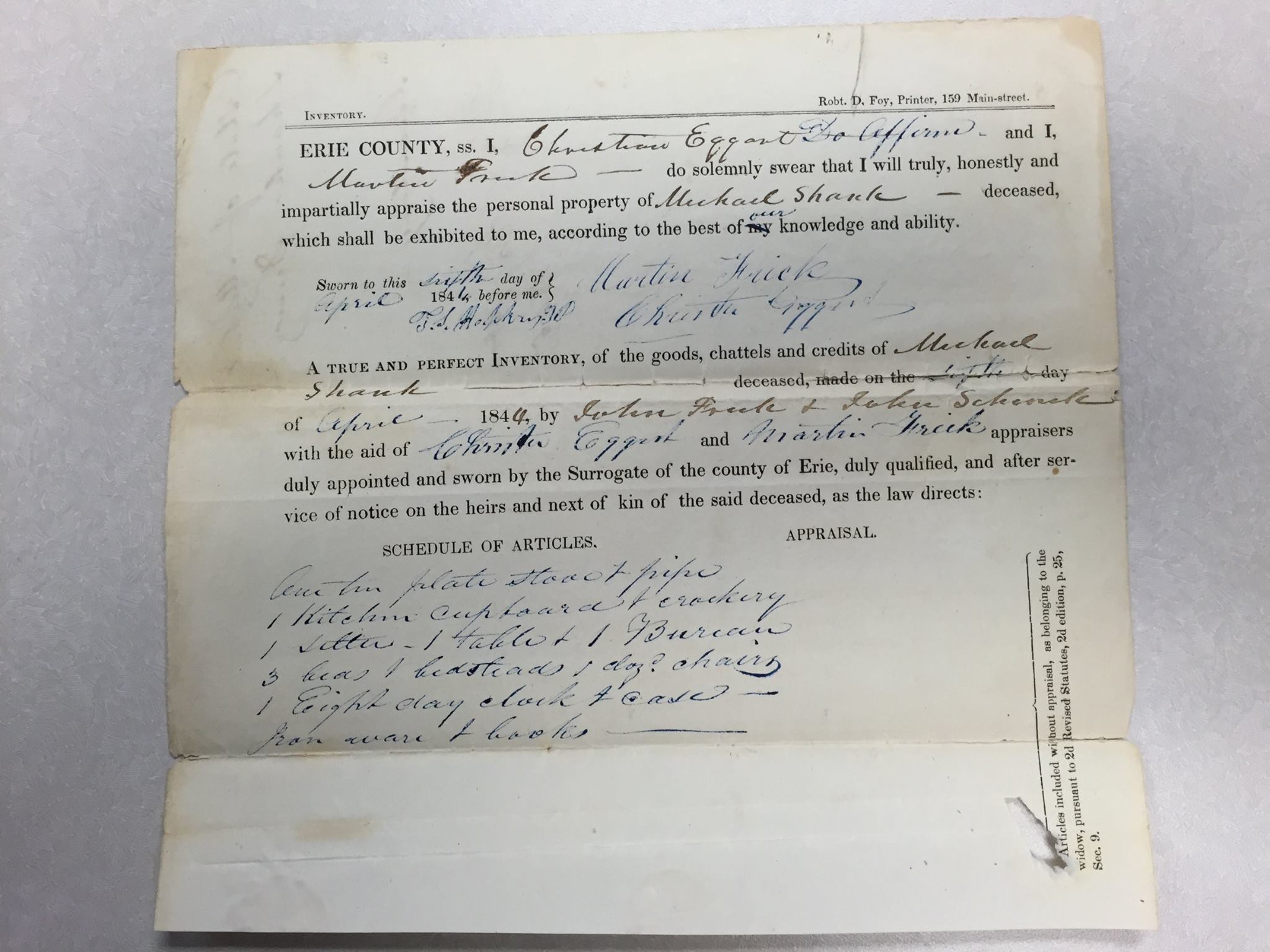


1840s Inventory with 10-plate stove and pipe

The Federal style has a central entrance door leading into a foyer with a floor plan of four rooms over four. Wheres, the Continental style was designed with central heating in mind, as Germans had developed the cast iron heating furnace and stove during the middle ages. With having imported their technology with them to America the houses continued to be centered on the stoves. The houses were arranged with three rooms over three, which off set the front entrance door to one side. The inventory from the 1840s for the Schencks lists a 10-plate stove with pipe in among several other items, a later inventory lists a new coal stove. However, the Schencks did not cook on their plate stove, it was a heater, they cooked out of their fireplace and pot chains are found in their inventory. Most interestingly, the walls of the house are three feet thick in the cellar, and two feet thick at the first floor tapering to the attic. For the Schencks, they were building to last centuries. Unfortunately, after only one year in their new home; first Sarah in the spring, then their two and three year old children passed, leaving Samuel alone.
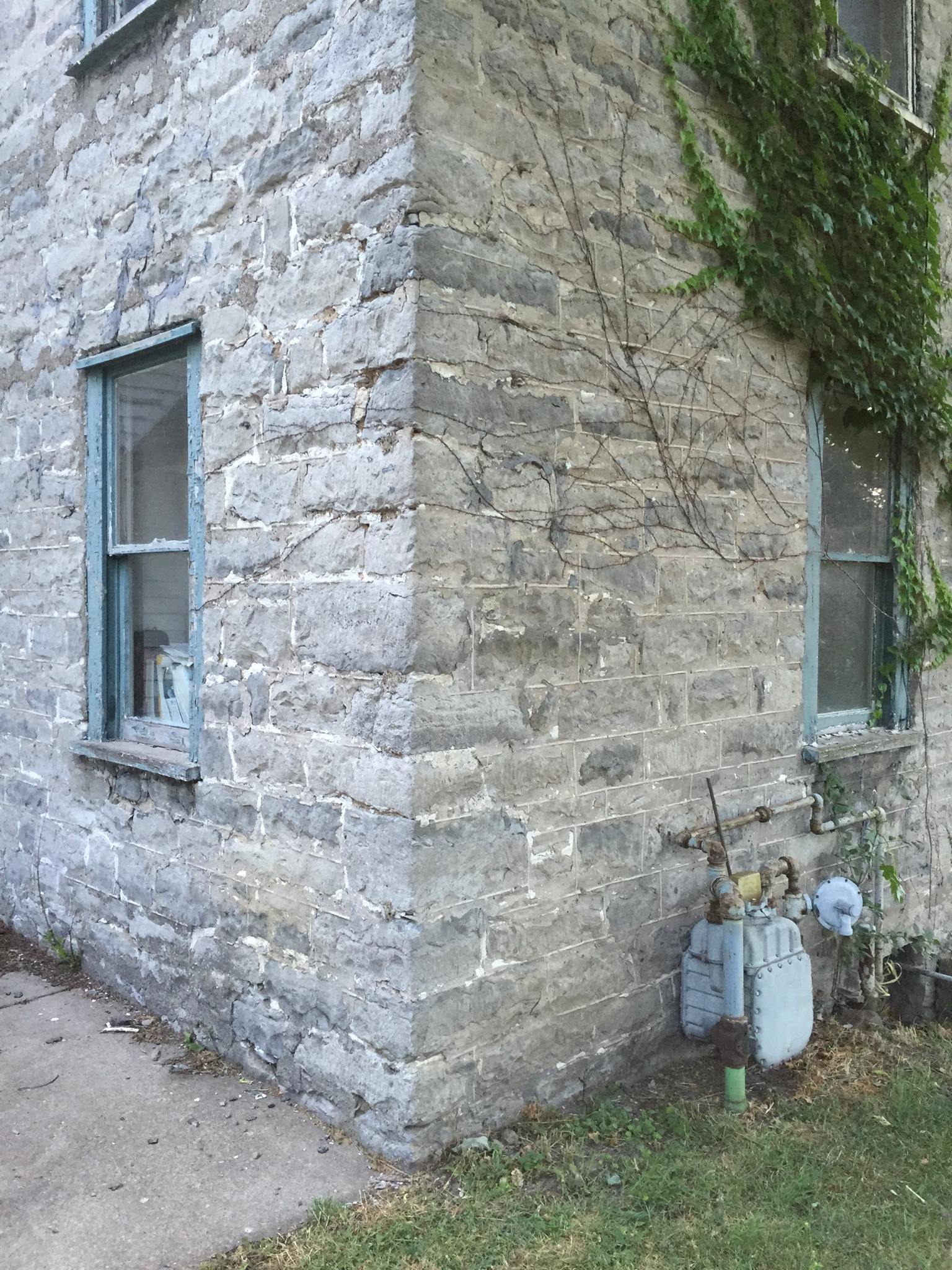


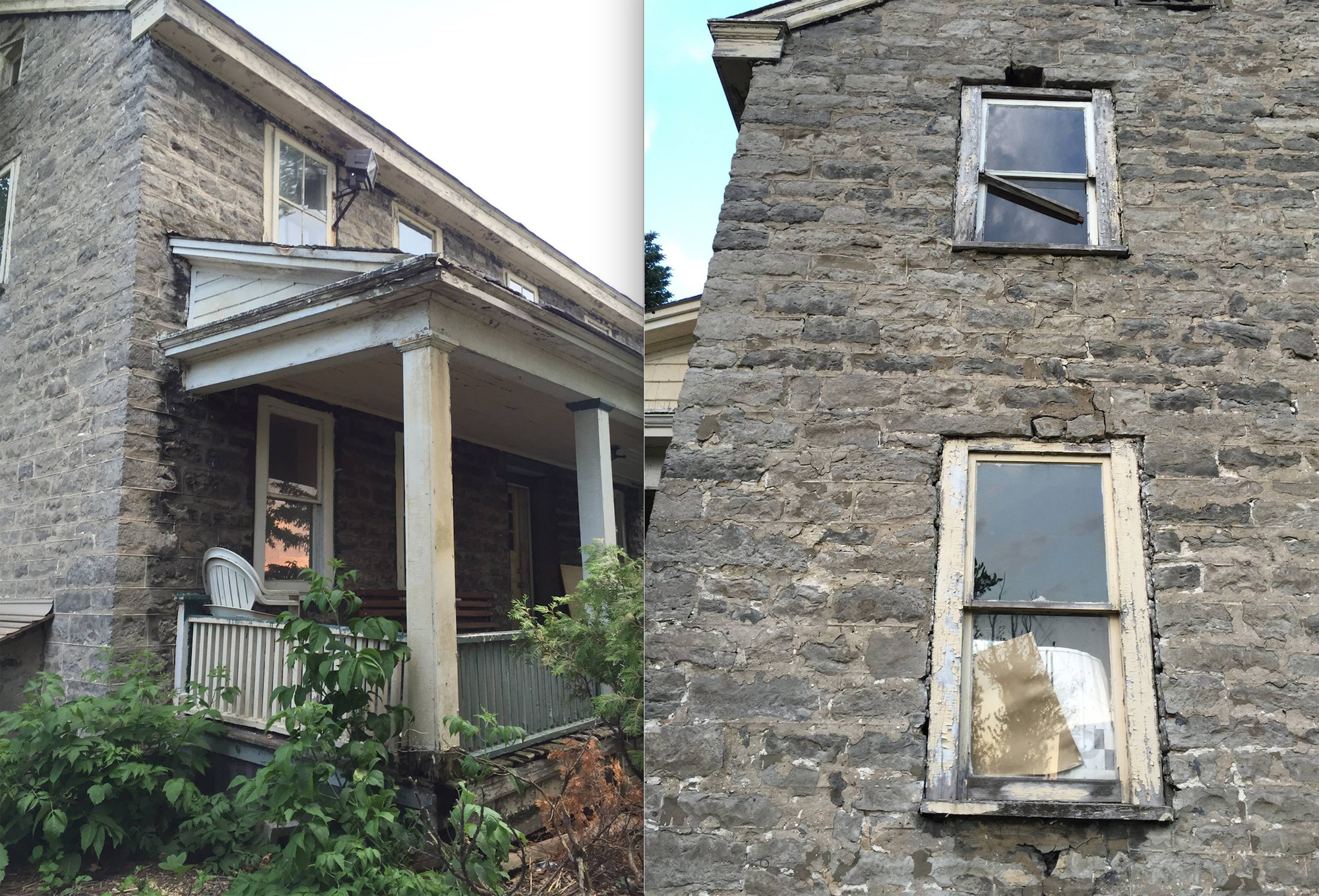
The Schenck house is one of two examples of homes from the early part of the 19th century within the City of Buffalo limits. The stone is locally queried limestone where fossils can be seen on the southwestern side (rear corner) of the house.

Its never a good idea to leave a widow rambling alone around a big stone house. It appears that one pastor spoke with another and the following year Samuel married Magdalena “Lena”; who lived just the other side of the lake in Canada. Canadians, according to the early census records were as enthusiastic as the Pennsylvanian Germans to move to Buffalo and Snyder. The Town of Amherst had 1,556 Germans and 364 Pennsylvanians arrive by the year 1850, or 43% of the total population. The City of Buffalo had 9,409 Germans, 69 Prussians and 376 Pennsylvanians by 1850, or 23% of the population. On top of this were a conservable number of Canadians and French people. Each census cycle, the Schencks are recorded as having German laborers working on the farm, and were likely bi-lingual. There has not been any evidence of them ever having owned slaves. 
The Schencks were unusual for other reasons too. Being of Continental European heritage, they not only loved central heating, they also brought with them a few other ideas thought both strange and marvelous to British- Americans. These unusual practices included; crop rotation, using manure as a fertilizer, letting land lay fallow to regenerate and the building of structures called barns. The English on-lookers were more amazed when they discovered that these immigrants built these massive barns to house their animals through the winter and even took time to grow hay and feed the animals during the cold months. This system of farming had developed during the later half of the middle ages; served the central Europeans well enough that the methodology persisted and was brought to America. 
“…the Germans differed from practically all other Pennsylvania farmers, with the exception of the few Dutch, in providing shelter for their animals in winter. A traveler of the mid-eighteenth century noted shortly after his arrival in Pennsylvania that cattle around Philadelphia were neither housed in winter nor tended in the fields; after having been in the country for some time, however, he remarked that while the English and Swedes had no stables, the Germans and Dutch had “preserved the custom of their country, and generally kept their cattle in barns during the winter….They kept their animals as warm as possible in winter, and thereby effected considerable savings in hay and grain, for they found that cold animals eat more than warm ones…. the Germans began to build large barns rather than houses. The attention paid by Germans to the construction of barns, which became the envy of the non-German countryside, was brought out by one observer of 1753, who commented that “It is pretty to behold our back-settlements, where the barns are large as pallaces, while the owners live in log hutts; a sign tho’ of thriving farmers….The vegetable gardens were filled with weeds, intermingled with cabbages, turnips, and other plants.” German Agriculture in Pennsylvania, 1959, page 197 [27]
While the Schenck’s lifestyle is easily visualized in part because of their early adoption of technology and their tendency to stick with (what we modern thinkers might call) environmentally friendly practices despite the growing tendency to adopt synthetic fertilizers and specialization; but because, in the Schenck House, the ladies were viewed as partners. The women were producing small batches of products for market including; apple butter, dairy butter, honey and barrels of “graag”. “Graag” is hard cider. It is possibly the only 19th century example in the City of Buffalo where the original site and records survive for a female entrepreneur. 
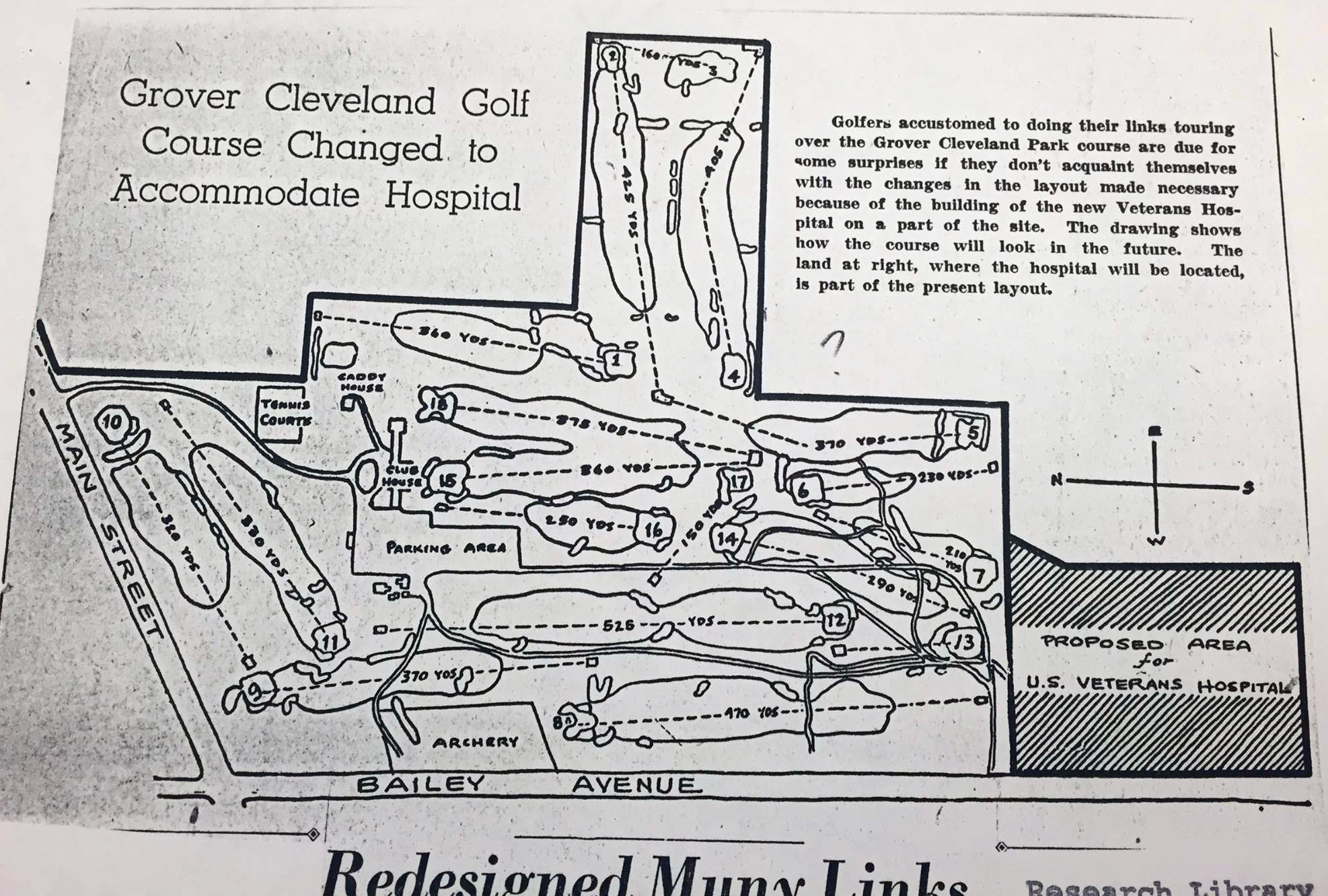


1918 Map of Grover Cleveland Golf Course – Schenck house and barn are left hand side of the central parking lot.

The property was first purchased by the Country Club of Buffalo who installed both a polo field and 18 hole golf course. Then resold to the City of Buffalo in 1927; where on the 1928 survey map we can see how the City promptly drew a bump out to include the farm and 18 hole golf course within the limits. The City renamed the property Grover Cleveland Park and Golf Course. In the 1970s and due to budget constraints, the City turned over the management – while retaining the property title – to Eire County. With ownership in the hands of the City and maintenance and Management in the County’s the Schenck house has survived in part because of the golf course. 
The Friends of Schenck House support Erie County and the 2003 Master Plan to restore the oldest stone house in the City of Buffalo. According to the Master Plan, “Another notable heritage aspect of the Grover Cleveland Golf Course is that the site has one of the oldest stone buildings in Erie County on it, possibly dating back as early as the 1810s. [The 1810 cottage no longer exists] This structure is currently used for limited offices and storage for the golf course operations, and is in need of upgrades to preserve its structural and architectural integrity.” and “Actions prescribed by the 2003 Erie County Master Plan…Consider the inclusion of the stone house and outbuildings on the National Register of Historic Places. Consider a public/private partnership in restoring the old stone house structure and associated out-buildings. Potential exists for a heritage- related museum, restaurant, upgraded golf course-related facility, meeting rooms, etc. Maximize the access and visibility to Main Street, the proximity to the University at Buffalo and the close proximity to some of the region’s most prestigious homes as major marketing advantages for future uses at this facility.” 
Our goal is to get Landmark status, replace the roof which is leaking, complete a restoration plan… and eventually get to the point where 1) the University of Buffalo’s Departments of Anthropology and Architecture can hold field classes on site 2) baking classes can be made available to the public 3) and for all the local brew and drink lovers out there… bring back Lena’s “graag” and install a still. (I’m thinking October Fest !) In this we would put into adaptive re-use a city owned house for the public events and generate on-going cash flow for maintenance of the site. If you are interested in being involved please message us through Facebook. We are looking for people with a variety of talents to lend a hand in bringing back a bit of our history for public use. 
Thank you, The Friends of Schenck House Est. 1822


Friday, March 16, 2018

America's First Microscope and Telescope Maker, Susanna Davis Sommer

Move over Charles A. Spencer, and Amasa Holcomb, Susanna Davis Sommer is America's first Microscope and Telescope Maker. 


You probably haven't heard of Susanna Davis Sommer, let alone that she was the first American microscope and telescope maker. She was a celebrated Dutch professional having practiced since the 1720s in the Netherlands, arrived in America in 1749, and advertised in the New York Gazette in 1751 and 1753 that she was a grinder of all sorts of glass lenses, producer of spectacles, four draw telescopes and microscopes. She achieve recognition in her own life time, with her scopes having been in the collections of common people and the nobility. Both the French and the English acknowledge her achievements too. Yet, we in America do not learn about her technological contributions from school classrooms, museums, or historical sites. That she developed a table top dissecting microscope and her own version of a projecting microscope, the first of which would be copied by later scope makers. She also happened to be a widowed at a young age and raised three children on her own. Later her grandson, Ananias Cooper would become a notable Philadelphian merchant and goes on to fight along side Washington at Valley Forge. At the time of her arrival in 1749, she was the only glass grinder in New York, making her the only source for domestically produced scopes available for field research during the enlightenment and for telescopes or spy scopes during the French and Indian war. She helped us into the enlightenment by providing what the French and English considered the highest quality lenses for science in the western world.

"A brass telescope with four draw tubes, made by "Juffrouw [ Widow] Sommert" was in the Amsterdam Aron de Pinto collection, together with a microscope by her hand." - From Earth-Bound to Satellite: Telescope, Skills and Networks, by BRILL. 

Last summer, I represented her in typical Dutch-American garb while demonstrating how to grind glass to tourist and children at Fort Erie on Lake Ontario. By the time I am done with the demonstration kids know the difference between convex and concave lenses, the name Susanna, and learn that physics is not all that scary. The best part was, they loved it! Sommer is someone I care a lot about and hope that you all will spread the word, that one hell of a lady was the first crafter of telescopes and microscopes in America !


Early Life: 

Susanna Davis Sommer's early life is not well known. There is some speculation by her decedents in the US that she was born in 1695 in Wisbeche, Cambridgeshire, England and prior to marriage went to the Netherlands. A survey of the babies born in this parish turns up one "Susanah Palmer" born in 1695; unfortunately, the surnames of Palmer and Davis do not line up and the birth year was likely inferred form the Palmer date.

I believe it is more likely that her parents and heritage are likely either German or Dutch. Possibly, being born on the continent with the English birth place being mistaken, or with the possibly of having moved to England with her parents as refugees and then moving to the Netherlands. This particular English parish had a number of protestant refugees settling in the region in 1695 opening the door to her being the child of people seeking religious freedom. Another clue to her heritage is that late in life she and her daughter Elizabeth later joined the German speaking Moravian Church, becoming one of the original founders of the Fulton St. Church in Manhattan and is possibly the reason for her coming to America. I do find it surprising she would leave a thriving business, but this may have also been a way for her to semi-retire from her notoriety.


A Partnership: 

Records for Susanna's life picks up around the time of her marriage. In 1727, her husband Balthasar took out an advertisement in a Dutch paper.

Optic Glasses.—Notice is hereby given, that Balthaser Sommer, could be contacted in Amsterdam, both at the coffee shop of J. van der Wal at the “Paradijsvogel”, Bird of Paradise, on the Rokin, or in The Haue, Grinds all sorts of Optic Glasses to the greatest Perfection, such as Microscope Glasses, Spying Glasses of all Lengths, Spectacles, Reading-Glasses, for near-sighted People or others; Also, Spying-Glasses of three Feet long; which are to set on a common Walking-Cane, and yet be carried as a Pocket-Book; all at the most reasonable Rates.” - November 10, 1727

Just two months later, we see a possible reason for Balthasar looking to drum up new customers. The baptism of what is probably their first child, Lea Susanna Sommer. Balthasar and Susanna will have two other daughters; Mary and Elizabeth Sommer who will later follow her to America.
De Nederlandsche leeuw, Maandblad van het Koninklijk Nederlandsch Genootschap voor Geslacht- en Wapenkunde, MAANDBLAD van het Genealogisch-heraldiek Genootschap „De Nederlandsche Leeuw." page 231, under the surname of "Sommer".

Van dezen naam is 19 Jan. 1728 in de Evangelisch Luthersche kerk te 's-Gravenhage gedoopt Lea Susanna, dochter van Balthasar Sommer en van Susanna Davis.  
Of this name is 19 Jan. 1728 in the Evangelical Lutheran church in The Hague baptized Lea Susanna, daughter of Balthasar Sommer and Susanna Davis.

While speculative, the three daughters would have likely helped their mother in the "studio". Later before moving to America, Susanna choose a buyer for her studio. The buyer was Nicolaas van Leewen who's apprentices were his own two daughters - Anna and "Sanderina" - who a few years later over his shop and place their first advertisement on May 10, 1757 as grinders of glass and producers of magnifying products. Like father like daughter / like mother like daughter... melts one's heart ! 

Unfortunately, Balthasar will pass in 1733 but not before having made a name for himself. It is likely that Balthasar was trained in Bavaria or in the Netherlands to be a glass grinder. He was quick to pick up on trends. A glass grinder can make a living making spectacles as seen below, however, Balthasar is known to have made handheld screw microscopes that could be used to explore the world around oneself. 

Marian Fournier produced a catalog following the history of the microscope. For instance, the screw microscope was invented in 1694 by the Dutch mathematician Nicolaas Hartsoeker, later James Wilson will make his version of the screw microscope in 1702. Edmund Culpepper was first apprenticed as an engraver and later in 1720 produced a print in exact duplicate of the screw microscope he had available. Unfortunately, we do not know when our Balthasar Sommer was born, but know he died in 1733. While it is possible he died at a young age, it is more likely he was both older and a contemporary of Edmund Culpepper. Balthasar too made a screw microscope according to Fournier. See "Early Microscopes, A descriptive Catalogue" Leiden: Museum Boerhaave, 2003.

In another book we find the following, "For instance, in that of the merchant Anthony Bierens (auctioned in 1747), some 30 optical objects were present, including “an object and an eye glass fitted in a wooden holder, for an astronomical telescope of B. Sommer”.136". See "From Earth-Bound to Satellite: Telescopes, Skills and Networks", edited by Alison D. Morrison-Low. The book notes that auctioneers used, "The famous Sommers", as they were considered a team, to promote the products of the various auctions.


By Her Own Hand:

Susanna Davis Sommer will produce microscopes and telescopes by herself for roughly 32 years, with half of those years being in America. 

With permission, a projection microscope made by Susanna Sommer in the collection of the Museum Boerhaave. This museum has one of the largest collections of microscopes in the world, with many interactive projects for children. The microscope below has a tube that is connected to the large square plate. The plate opens like a book. Inside is a mirror on one side and the input lens to the tube on the other. The mirror reflects light from the sun onto the specimens plate and through the tube to a wall. Very similar to the overhead projectors used in schools from the 1980s and 1990s.


Her ingenuity was recognized by the English:

The book: “The microscope made easy or Describe the best and newest microscopes and any treatment. As a compliment of the amazing discoveries made with the magnifying glasses.” - by Henry Baker, 1744 
Page 8 - The solar microscope of Lord [Heere] Wilson (This system)… is sufficiently similar to that of the Lord Sommers, for what many years have been in use among our Dutch comrades, and now at the widow's own [hand], living in Amsterdam on the Reguliers gragt at Kerkstraat, is being sold.”
Page 10 - [For the Wilson's screw microscope]... “”M" is a flat strip of ivory, called a shackle [specimens’ holder], with four round holes there, in which the objects are placed between two Muscovich [glass] slides, showing the same d, d, d, d [on diagram]...
*Instead of Muscovich glass, the objects in the above-mentioned System of Sommer, Placed between two separate skeins of French or England glass thereto, which for some comrades will be preferred.” 

Did you catch that ? Wilson's are similar enough (a.k.a "good enough") to the long standing Sommer's scope, to be used by researchers. This comparison is like saying that while I love and own a VW coup... its still not a porch. More interestedly, why weren't the French or English using their own glass if it was of a better quality? Unfortunately, I am not sure of the difference between using two "slides" vs. two "skeins" but it seems to have improved the quality, and the author complains that systems that do not use the skein style have a difficult time with their specimens moving (floating) impeding observations. 

After this publication we find two advertisements likely capitalizing on her recent publicity.  In 1744 the adds read, "Optic Glasses.—Notice is hereby given, that Widow of Balthaser Sommer, could be contacted in her shop on the Reguliersgracht in Amsterdam...". Another add is taken out the year before she leaves for American in 1748, with her studio being sold to van Leewan, and Sommer arriving in America in 1749. 


In America:

Traditionally, New York has required immigrants to live in the colony for one year prior to applying for Freeman status, which allows a person whether merchant, tailor or candle stick maker to sell and carry on business. It was also a bit of a status position, as gentlemen also registered despite not having an occupation. There was not a stigma for a gentlemen of means to choose to join a group made up of primary people with jobs. The Freeman status was given to people who applied for it and paid a fee, and was in keeping with the Burger roll that had preceded it. Interestedly, those people with prior Burgher status could pass this onto their sons and son-in-laws and it continued right into the 19th century in New York. The Burgher rolls of New York included people of Dutch, German, English and other ethnicities, plus a number of women. Unfortunately, the Freeman rolls are not complete, and I could not find our Susanna Davis Summer. 

New York City's population in 1750 was about 12,000 people, and while not the largest port, it was the largest warehousing facility in the colonial era. The "Vitals" of New York has one "Elizabeth Somers as resident in 1751. Elizabeth Somers is her daughter, likely the youngest. Later, Elizabeth "Sommers" (1729-1785) born at Gravenhaag marries Reverend Andrew Langaard in 1763 a pastor in the Moravian church in Pennsylvania. In 1752, her daughter Maria Elizabeth Sommer is also listed as "Resident". Maria or Mary marries while still back in the Netherlands to the merchant Cornelius van "Kuyper". Right after their arrival in 1753, their child Ananias "Cooper" was born on August 31st, 1753 and baptized on September 3rd, 1753 in the Moravian church on Fulton St. in Manhattan. Later Ananias will marry Bridget Burke in Philadelphia. His advertisement is below:
Brush Manufactory.—Hogs Bristles....The Subscribers having erected a Brush Manufactory at No. 4, Peck's-slip, where they propose carrying on the brush making business in all its branches, Store-keepers and others may be furnished with all sorts on as low terms as any imported, to which they hope the preference will be given them, as the work is equally good if not better; and as they will warrant their work not to fail till worn out by use, they flatter themselves with expectation of getting a sufficient supply of this country bristles, that they may not be under the necessity of importing their stock from England; the farmers, by being careful in the season of killing, may have sufficient to supply them in this business. Country store-keepers would be the most proper persons to collect them. Ananias Cooper and Company.—New-York Daily Advertiser, December 26, 1787.

Susanna Sommer's first advertisement in the NewYork Gazette or Weekly Post Boy was in 1751 and the second in 1753 to notify everyone that she had moved to a new location.

1751 - “Widow of Balthaier Sommer Grinds All Sorts of Optick Glasses.
Notice is hereby given to all persons, that the widow of Balthaier SOMMER, late from Amsterdam, now living in “Beekman-Street, New York, next door to Mr. Lodowick BAMPERS [ No. 24 Beekman St. ], grinds all sorts of optics glasses to the greatest perfection, such as microscope glasses, spying glasses of all lengths, spectacles, reading glasses, for near sighted people or others. Also spying glasses of three feet long, which are to be set on a common walking cane, and yet be carried in a pocket book, all at the most reasonable rates. -The New-York Gazette or the Weekly Post-Boy, October 18th, 1751.
1753 - Optic Glasses.—Notice is hereby given, that the Widow of Balthaser Sommer, late from Amsterdam, now lives next Door to Mr. Laffert's on Pot-Baker's Hill, in Smith-Street [ William St. ], New-York, Grinds all sorts of Optic Glasses to the greatest Perfection, such as Microscope Glasses, Spying Glasses of all Lengths, Spectacles, Reading-Glasses, for near-sighted People or others; Also, Spying-Glasses of three Feet long; which are to set on a common Walking-Cane, and yet be carried as a Pocket-Book; all at the most reasonable Rates.—The New-York Gazette or the Weekly Post-Boy, May 21, 1753.

Interestedly, Mr. Bamper may have owned a glass shop and black smith shop at No. 24 Beekman St.

Glass House.—To be sold...The well known houses and lots of ground, with a large carpenter's and blacksmith shop of the late Lodwyk Bamper, deceased, No. 24 Beekman street New York...—New York Packet, January 26, 1787.


While the English in 1744 recognized her work prior to her immigration to America, after immigration, the French in 1762 claimed her instruments as being the preferred tool for exploring the microscopic world during the enlightenment. The author wrote politely pointing out how his Wilson dissecting microscope was a good enough copy of Susanna's cabinet mounted instrument. The one difference of the later Willson microscope being tweezers added to the base cabinet so to hold the specimens in place, as compare to putting it between slides/skeins like Sommer's microscopes. It is important to note that the cabinet top dissecting microscope post-dates Balthasar's active years. We can place the Sommer's version of handheld screw microscope in his court, while the cabinet top directing microscope in Susanna's.


Recommends... “de se servir du Microscope à Vis de Sommers & de Wilson, sans que l'on soit obligé de le tenir;” - Book: “Traite anatomique de la chenille: qui ronge le bois de saule” , by Pierre Lyonet, 1760

After the French and Indian war, on March 14, 1765, Susanna will die while being a member of the Moravian Church (est. 1741) in Bethlehem, Pennsylvania. When exactly she retired to PA, is unknown.

It is difficult to say just how many decedents can claim ancestry to this first of their kind American, but through Mary Elizabeth who appears to have had one child, Anasian Cooper, she can claim five grandchildren. It is unknown if Elizabeth who married a Moravian church pastor had any surviving children. Lea Susanna appears to have stayed in the Netherlands. According to the magazine De Nederlandsche leeuw, Maandblad van het Koninklijk Nederlandsch Genootschap voor Geslacht- en Xapenkund, which publishes genealogies there were a number of them. It is possible that she married into the Cornelis Michielsen Schimmelpenning family line who was born around 1557, though it is not clearly stated how she is related.  It made note of Lea Susanna's baptism in 1728 and who her parents were.

I do have one request form you all. I have been searching for examples of her work, but I believe her work may have been unsigned, at least for the smaller pieces. One modern historian of lenses sights having read/seen the initials "Juffrouw Sommert" as being used by Sommer, while B. Sommer is used while they are married. They turn up in old auction catalogs and museum inventories, though I could only source one photo. If anyone comes across a "sommer" scope, please add its location to the comments section.


Thank you !


Secondary sources:


Thinkers and Tinkers Early American Men of Science, New York, by S. Bedini, 1975, pp 215-216


The New York Genealogical and Biographical Record, Volume 52 , edited by Richard Henry Greene, Henry Reed Stiles, Melatiah Everett Dwight, George Austin Morrison, Hopper Striker Mott, John Reynolds Totten, Harold Minot Pitman, Louis Effingham De Forest, Charles Andrew Ditmas, Conklin Mann, Arthur S. Maynard

A History of the Moravian Church in New York City, By Harry Emulous Stocker

A Register of Members of the Moravian Church: And of Persons Attached to Said Church in this Country and Abroad, Between 1727 and 1754. Transcribed from a Ms. in the Handwriting of the Rev. Abraham Reincke, to be Found in the Archives of the Moravian Church at Bethlehem, Pa., and Illustrated with Historical Annotations, H. T. Clauder, printer, 1873.

Saturday, January 20, 2018

Rucksack and Knapsack - 1530 - 1755


1651 Probate Inventory, Manhattan, a brewer, een "reyssackie" [a rucksack] 

The rucksack and knapsack are items that can easily be traced back to the 1530s and were used throughout the 1600s and 1700s. The rucksack is often seen on people when carried on their backs as a cross body bag. Wheres, knapsacks are smaller and carried slung over the shoulder or hanging from a stick vagabond style. The two bags form a set used by travelers; though sometimes I get the impression that they are one and the same.

Below: Cropping of a traveler visiting a "The Doctor's surgery", Attributed to Michiel van Musscher (Rotterdam 1645-1705 Amsterdam)


In Inventories:

For reenactors this is a very practical and useful item, which can be worn by men, women and children. It also allows you to keep your arms free during events, while keeping anything you deme too valuable to leave behind in a tent with you at all times but on your back. Below are references to the rucksack. I don't have a knapsack in the inventories from the 1640s-1790s.

New Netherland Probate Inventories:

1651, Manhattan, a brewer, een "reyssackie" (a rucksack)
1664, Wiltwijk [Kingston, NY], a farmer, a rucksack

Thanks to Mr. Oovenmeester Richard, a 17th Century reenactor, who found the first photo of a rucksack for me; it also lead me to find a few others. The black bag below is an extant from the 17th Century and is located at the Geheugenvan Nederland Museum Link. And another photo Here and Here ... and one more Here.

FYI, if you type in "draagzak" or "voorraadzak" you get the photos linked above and baby carriers.


Making a Connection:

After seeing a number of these rucksacks in paintings and images I got it in my head that this would be a handy bag to take with me to the park, when visiting historic sites, and simply to enjoy a connection with the people who made the journey across the Atlantic. I managed to find a modern maker of these bags and thought I would share. I don't get a referral fee, instead my goal is to supply my readers with links to well made items produced by small shops just like they would have 300 years ago.

Check out Chris Thomas's 17th Century linen canvas and (pictured below) a golden goatskin rucksack which are "made to order" items, you get to pick what your rucksack is made of. Chris can be contacted through email: christophus@aol.com or through Facebook at Christophus Leatherwork & Trading. His Facebook page is a tour through time, with many images of items Chris is working on for special orders and even museums.


Plus, this is really awesome 17th century water bottle ! Here. by Graham Webb.  Image woman with water bottle here.


Historical References:

Any reenactor or historic site whether in England, Europe or America knows that primary sources count when picking out what to use or display. Here are documents that mention these items from 1755 back to 1530 and give clues on how they are used.


1755 - "...the knight and squire therefore, dismounting, and leaving the ass and Rozinante at pleasure to regale themselves with the rich pasture, emptied their knapsack, and without any ceremony, attacked the contents, which they ate together like good friends..." - The History and Adventures of the Renowned Don Quixote, Volume 1, 1755

1716 - "...On the other hand the mis-spelling of English words such as " consort " for "concert," "snapsack" for "knapsack," "rabbet" for "rabbit," "teint" for " tint ...and the use of "my Lord" for "Sire" or "Signeur", give the idea that the translation published by Tonson has been made not by an Englihsman but by a Foreigner." - Book: Gil Blas, By Alain Rene Le Sage, 1716.

1708 - "Havresac, f.m. Bifsac de fantassin. Een Soldaat knapzak." (Also Besace, Bifsac. Bedelzak, knapzak) - Groot Fransch en Nederduits woordenboek, 1708 

1708 - "Havresac, f.m. Bif-bag of infantryman. A Soldier's Knapsack." (Begging bag, also a knapsack) - Groot Fransch en Nederduits woordenboek, 1708 

1688 - "I heard Sir Thomas Fairfax relate of a Souldjer in Ireland, who having got his Passport to go for England, as he past through a Wood with his Knapsack upon his Back, being weary, he fate down under a Tree, where he open'd his Knapsack, and fell to some Victuals he had; ..." - Book: "Epistolæ Ho-Elianæ: Familiar Letters, Domestic and Forren. Divided Into Four Books, Partly Historical, Political, Philosophical, Upon Emergent Occasions", 1688

1530 - "...Gott für einen narren/der unnötige stifte uns ordnet/und nicht wuste/ was er uns stifften sollen odder als were er ein knapsack / der faule untuchtige wahr umbhertruge und unsanböte /..." - "Vermanung zum Sacrament des leibs und bluts unsers Herrn" by Martin Luther 1530

Translation:
1530 - "...God for a fool / useless pen arranges us / and not wust / what he should stifften us or as if he were a knapsack / lazy naughty true umbhertruge and unsanböte / ..." - "Vermanung zum Sacrament des leibs und bluts unsers Herrn" by Martin Luther 1530.


This last one, 1530, was a bit too hard for me to translate correctly. But we get the idea that everybody liked knapsacks and they had one particular purpose, to carry food. This is compared to a rucksack which was used for travel.